


Why NOT k&n


Senior Member
Joined: Apr 2005
Posts: 3,009
Likes: 0
From: In a van down by the river
Originally Posted by dzervit
Been there, done that. I had the K&N drop in with my factory intake that takes are right from the fender well... not the engine bay. It was nice, but not earth shattering. The AF1 dropped two tenths of my ¼ times. Check the 'TT Performance #s, Post AF1' thread in the '04 forum. No dyno, just real world driving....
... but I'd also love to get a K&N kit and show that the little extra HP the AF1 produces doesn't mean jack & see if its quieter. So anyone with K&N they want to send to Detroit for a week or so?
... but I'd also love to get a K&N kit and show that the little extra HP the AF1 produces doesn't mean jack & see if its quieter. So anyone with K&N they want to send to Detroit for a week or so?
There is no debate on AF1 providing the best gains and performance. However, are the gains that AF1 has over the K&N large enough to make such a difference that someone who is looking for a aftermarket intake, but wants less sound than the AF1, should stay away from K&N because of performance.
In other words, someone who is looking for an aftermarket intake but wants less sound than what the AF1 provides, and is willing to sacrifice *SOME* performance for it. Does the K&N fit this bill.
Mike obviously has the superior knowledge and testing in this area. To each his own on sound, I think dzervit is just looking for a solution for the more audibly sensitive F150 owners.
Nobody is trying to say that K&N numbers are better than AF1. The question is, is K&N safe and will it post moderate numbers. I think a new market for air intake will be found in the owner who wants some gains, but wants to reduce the noise of AF1. Question being, is K&N that solution?

Senior Member
Joined: May 2004
Posts: 5,409
Likes: 1
From: Sunny FL
There’s nothing not to like with my setup. Some mild exhaust sound all the time, but no drone at any speed. The AF1 is quiet when cruising or anything less than ¾ throttle but when you kick it then it roars along with the exhaust.
Must be that some trucks react differently because I can drive people around all day long and never hear a peep out of anyone about excessive noise because there isn’t any. I look and sound totally stock until the hammer drops
Must be that some trucks react differently because I can drive people around all day long and never hear a peep out of anyone about excessive noise because there isn’t any. I look and sound totally stock until the hammer drops

Senior Member
Joined: Mar 2002
Posts: 4,867
Likes: 0
From: NH
Mike,
Not sure if your last post were aimed at me but if it was then let me clear a few things up. First, I don’t argue time and time again about anything you may say. I may disagree at times but I have also backed some of your claims up at times as well.
Second, nothing I have ever stated was nonsense. You may not agree with it but that does not make it nonsense but rather a different perspective. I do understand testing in controlled environments because I have done testing in controlled environments.
A controlled test is a great tool for analyzing and/or comparing like test units (i.e. one brand of electric motor vs. another with the same or very like characteristics). A controlled test is just that, very controlled with very little variables. If there are a lot of variables in a controlled test it is a flawed controlled test, unless of course, those variables are purposely introduced into the test in a controlled manner. It is the opposite of “real world” testing because “real world” testing has many variables, some controllable to a point and others with no control.
I did give an example of how some open element air intake systems are tested in a “controlled test”. The example I mentioned was the fact that many manufactures test them with the hood open. That may be great for a “controlled test” but has no relevance to the “real world” where no body drives around with the hood open and thus the horsepower and torque gains stated in the test are not reliable since the testing was flawed to begin with.
The same thing can be stated about testing with Dyno’s. They are controlled and are great for diagnostics, analyzing and comparing things. They don’t however represent what one would find in the “real world”. Probable the most important thing to remember about testing with a dyno is there is no way to actually reproduce true driving conditions. The most important being wind flow and wind speed.
That is probably why many manufactures test open element air intake systems with the hood open since there is no way to accurately get the wind to flow as it would on the open road to feed it. The same could be stated about “true” cold air intake systems.
Now, if one was to dyno test or “real world” test two equally designed air intake systems (i.e. same cfm capabilities) then the “true” cold air intake system would win. As was mentioned most likely not by much or enough to matter but nonetheless it would slightly edge out the open element, physics are reality and no getting around them.
I think any arguments I have ever made have been done in a respectful manner and I don’t believe I have ever put someone down or called what they had to say nonsense.
I simply presented a logical and sound opinion which may differ from others, including yourself. I have always respected your opinion, and still do, and don’t think for a moment that you mislead people. I make the statement about mislead because that is a one thing that comes across to me about your prior post.
I hope you don’t feel that way or think I feel you mislead people because I do not. Just my engineering mind that looks at things, read things, analyzes, researches and then post an opinion. It may not always be correct but I try my best to present a logical and informative argument.
If anyone wishes to post data (dyno, controlled, or real world ¼ times) of two equally designed air intake systems (i.e. same cfm) one being an open element and one being a cold air intake that shows the open element gaining more horsepower and torque over the cold air intake I will then admit I am wrong. Until then I stand on my prior arguments
Mike you are a great person with not only lots of information, great products, and fantastic customer service, but the vast majority of the time very respectful of others. I hope my prior post did not offend you or upset you as that was not the intention. If they did then I apologize and ask you to re-read them but this time with an engineering hat on as they never knocked your product, you or your services to the community here. What they did address is two different engineered designs involving physics and physical construction.
Not sure if your last post were aimed at me but if it was then let me clear a few things up. First, I don’t argue time and time again about anything you may say. I may disagree at times but I have also backed some of your claims up at times as well.
Second, nothing I have ever stated was nonsense. You may not agree with it but that does not make it nonsense but rather a different perspective. I do understand testing in controlled environments because I have done testing in controlled environments.
A controlled test is a great tool for analyzing and/or comparing like test units (i.e. one brand of electric motor vs. another with the same or very like characteristics). A controlled test is just that, very controlled with very little variables. If there are a lot of variables in a controlled test it is a flawed controlled test, unless of course, those variables are purposely introduced into the test in a controlled manner. It is the opposite of “real world” testing because “real world” testing has many variables, some controllable to a point and others with no control.
I did give an example of how some open element air intake systems are tested in a “controlled test”. The example I mentioned was the fact that many manufactures test them with the hood open. That may be great for a “controlled test” but has no relevance to the “real world” where no body drives around with the hood open and thus the horsepower and torque gains stated in the test are not reliable since the testing was flawed to begin with.
The same thing can be stated about testing with Dyno’s. They are controlled and are great for diagnostics, analyzing and comparing things. They don’t however represent what one would find in the “real world”. Probable the most important thing to remember about testing with a dyno is there is no way to actually reproduce true driving conditions. The most important being wind flow and wind speed.
That is probably why many manufactures test open element air intake systems with the hood open since there is no way to accurately get the wind to flow as it would on the open road to feed it. The same could be stated about “true” cold air intake systems.
Now, if one was to dyno test or “real world” test two equally designed air intake systems (i.e. same cfm capabilities) then the “true” cold air intake system would win. As was mentioned most likely not by much or enough to matter but nonetheless it would slightly edge out the open element, physics are reality and no getting around them.
I think any arguments I have ever made have been done in a respectful manner and I don’t believe I have ever put someone down or called what they had to say nonsense.
I simply presented a logical and sound opinion which may differ from others, including yourself. I have always respected your opinion, and still do, and don’t think for a moment that you mislead people. I make the statement about mislead because that is a one thing that comes across to me about your prior post.
I hope you don’t feel that way or think I feel you mislead people because I do not. Just my engineering mind that looks at things, read things, analyzes, researches and then post an opinion. It may not always be correct but I try my best to present a logical and informative argument.
If anyone wishes to post data (dyno, controlled, or real world ¼ times) of two equally designed air intake systems (i.e. same cfm) one being an open element and one being a cold air intake that shows the open element gaining more horsepower and torque over the cold air intake I will then admit I am wrong. Until then I stand on my prior arguments
Mike you are a great person with not only lots of information, great products, and fantastic customer service, but the vast majority of the time very respectful of others. I hope my prior post did not offend you or upset you as that was not the intention. If they did then I apologize and ask you to re-read them but this time with an engineering hat on as they never knocked your product, you or your services to the community here. What they did address is two different engineered designs involving physics and physical construction.

Senior Member
Joined: May 2005
Posts: 1,454
Likes: 0
From: Cary, NC
Originally Posted by 01 XLT Sport
If anyone wishes to post data (dyno, controlled, or real world ¼ times) of two equally designed air intake systems (i.e. same cfm) one being an open element and one being a cold air intake that shows the open element gaining more horsepower and torque over the cold air intake I will then admit I am wrong. Until then I stand on my prior arguments.


Senior Member
Joined: Apr 2004
Posts: 4,424
Likes: 0
From: Motor City
Hell, does nobody get what XLT is trying to say? Cold air = more power. Period. When you draw ONLY cold air and NO hot underhood air you will obviously gain more HP... how much is the question, but odds are it will not be enough to produce significant results at the track.
Senior Member
Joined: May 2005
Posts: 1,454
Likes: 0
From: Cary, NC
Originally Posted by dzervit
Hell, does nobody get what XLT is trying to say? Cold air = more power. Period. When you draw ONLY cold air and NO hot underhood air you will obviously gain more HP... how much is the question, but odds are it will not be enough to produce significant results at the track.

Senior Member
Joined: Mar 2002
Posts: 4,867
Likes: 0
From: NH
Originally Posted by hwm3
If your so sure that your right, why don't YOU do the testing? It seems to me that until YOU do your own testing, all you really offer is opinion.
Cold air is more dense then warm or hot air. The more dense air is the more oxygen it contains, the more oxygen and fuel introduced into each cylinder of a motor, the more horsepower produced to a point unless you make modifications to the motor.
The point to remember is I am talking about two equally designed systems not an open element vs. stock cold air intake. An open element will normally allow more air flow, or more cfm vs. a stock cold air intake and thus the reason you would see a little more horsepower from an open element compared to a non-modified (i.e. paper filter) stock air intake system.
Senior Member
Joined: May 2005
Posts: 1,454
Likes: 0
From: Cary, NC
As far as the noise issue goes, read this.
I have an AF1 on order and should be receiving it soon. At that point I will be able to comment more on the sound and performance gains. 
Originally Posted by Superchips_Distributor
Any low-restriction intake is going to give a little bit more noise when accelerating at full-throttle at any rpm, and on any vehicle. The Air Force One is the best and the quietest in this regard, by far, and I do not see that as being an issue in these smooth & quiet vehicles. All the other intake kits are significantly louder, especially on part-throttle where you do 99% of your driving, where you want what is called "intake moan" the least - so I heartily recommend the AF1.
Senior Member
Joined: May 2005
Posts: 1,454
Likes: 0
From: Cary, NC
Originally Posted by 01 XLT Sport
You’re correct, mine is an opinion based on sound logics of physics:
Cold air is more dense then warm or hot air. The more dense air is the more oxygen it contains, the more oxygen and fuel introduced into each cylinder of a motor, the more horsepower produced to a point unless you make modifications to the motor.
The point to remember is I am talking about two equally designed systems not an open element vs. stock cold air intake. An open element will normally allow more air flow, or more cfm vs. a stock cold air intake and thus the reason you would see a little more horsepower from an open element compared to a non-modified (i.e. paper filter) stock air intake system.
Cold air is more dense then warm or hot air. The more dense air is the more oxygen it contains, the more oxygen and fuel introduced into each cylinder of a motor, the more horsepower produced to a point unless you make modifications to the motor.
The point to remember is I am talking about two equally designed systems not an open element vs. stock cold air intake. An open element will normally allow more air flow, or more cfm vs. a stock cold air intake and thus the reason you would see a little more horsepower from an open element compared to a non-modified (i.e. paper filter) stock air intake system.
Senior Member
Joined: Mar 2002
Posts: 4,867
Likes: 0
From: NH
Originally Posted by hwm3
I understand exactly what he's saying and it's pretty logical thinking. I also understand that things don't always work the way they SHOULD by all logic and theory. If someone was to test and market a true CAI system and prove gains over the currently available open element systems, that would be great. So far, that hasn't happened.
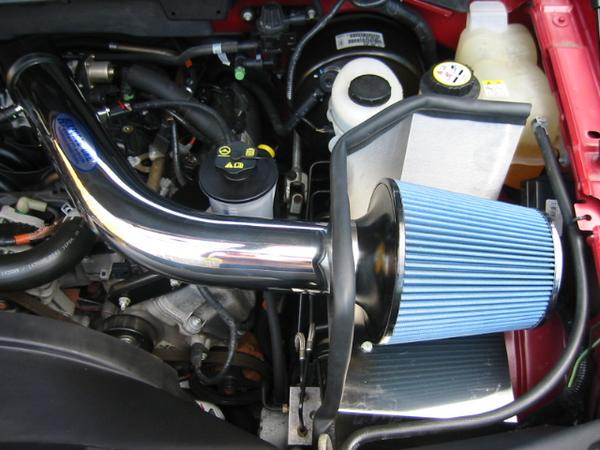
I will try to find some pictures of the modified open element Lightning air intake systems. Many Lightning owners have open element intakes but they have a box around them and when the hood closes it basically makes them a cold air intake. Lightning's come stock with a cold air intake system like other F150's.
I have no data, but have read many posts by other Lightning owners they did see some gains from utilizing these boxes. Reason being it kept most the hot air out. Mind you, and has been stated by Mike and others, this hot air is only there for seconds once you start driving, but in the ¼ mile a few seconds will cost you some time in the ¼ mile. I wish I knew the name as “box” sounds like some cheap flimsy looking thing of which they are not.
Picture from JohnnyLightning:

Last edited by 01 XLT Sport; Oct 3, 2005 at 09:03 PM.

Senior Member
Joined: Mar 2001
Posts: 1,919
Likes: 0
From: Western Massachusetts
I have seen pics of an intake that recieves it's air from under the front bumper (in the Lightning section). The filter is in it's usual place. That's what I thought you were referring to '01.
Senior Member
Joined: May 2004
Posts: 5,409
Likes: 1
From: Sunny FL
Originally Posted by dzervit
Hell, does nobody get what XLT is trying to say? Cold air = more power. Period. When you draw ONLY cold air and NO hot underhood air you will obviously gain more HP... how much is the question, but odds are it will not be enough to produce significant results at the track.

Senior Member
Joined: Apr 2004
Posts: 4,424
Likes: 0
From: Motor City
Originally Posted by jpdadeo
Maybe you should inform AF1, Airaid, K&N and all the other companies that make CAI systems they got it all wrong. A little box around the filter and presto-changeo *more hp*
Not only that, it's a matter of $$. More R&D, Higher product costs, etc... and would it be worth a few extra ponies? Odds are no. It's a balance between HP gained and cost. $300 for 20hp or $350 for 23hp. Marketing plays a large role as well.
If I put a scoop right over my AF1 and enclosed it so it drew air from the fender & hood scoop, I think I could sqeeze out a better time on the ¼.
XLT makes a very valid argument and the theory is solid.