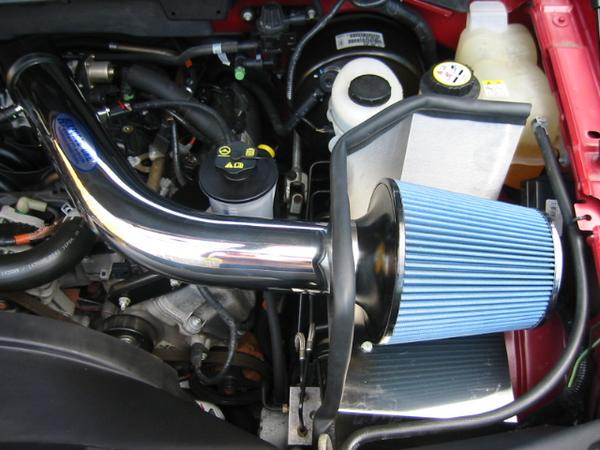
Why NOT k&n


Senior Member
Joined: May 2005
Posts: 576
Likes: 0
From: Alabama
"By the way - this isn't Vietnam, this is F-150 Online. Nor is our data 30 years old, very poor analogy."
Hey, at least you're reading my posts. I'm happy about that. Even if you derive a meaning that was not my intent.
"First - this is the Chips & Programming section - not the intake section."
Just where is this....a....."intake section"?
Sure seems you do a lot of mentioning about the AF1(always positive) and other intakes(mostly negative) on this "Chips and Programming" section. Should I provide links or would you prefer to do a "search"?
Joey
Hey, at least you're reading my posts. I'm happy about that. Even if you derive a meaning that was not my intent.
"First - this is the Chips & Programming section - not the intake section."
Just where is this....a....."intake section"?
Sure seems you do a lot of mentioning about the AF1(always positive) and other intakes(mostly negative) on this "Chips and Programming" section. Should I provide links or would you prefer to do a "search"?
Joey

Suspended
Joined: Dec 2002
Posts: 638
Likes: 0
Originally Posted by hwm3
Are you interested in purchasing an intake kit? Will you ever stop trying to discredit TP on this forum? 

Senior Member
Joined: Mar 2002
Posts: 4,867
Likes: 0
From: NH
It is not a matter of what someone states or advertises. It is only about the data, at least for the educated shopper.
The AF1 is an open element and may provide the most hp and torque in its “class” but lets see some data to compare the AF1 open element against all other intake systems including “true” cold air systems that do not suck in the hot air from the engine bay…
No, as a matter of fact I am not. I never stated anything to be a fact. What I did state was that I was willing to bet that if you dropped in a K&N filter into the factory “true” cold air intake system you “might” see the same horsepower gains, or close to, as you do with the open element AF1.
If you think I am dreaming then post some data. Data is fact, advertisement and word of mouth are just that, not fact at all…
I will go one further if someone is willing to send me a FREE AF1 for testing I will data log it against my drop in K&N in my Lightning. I will data log it in city driving and freeway driving and go to my favorite test area and do some ¼ runs and post the data for all to see…
So, anyone willing to put up? Needs to be quickly because towards the end of October, November I put my Lightning up for the winter. You want real world data not something from a dyno. Data from a dyno is good, but it is not real world or real conditions.
The AF1 is an open element and may provide the most hp and torque in its “class” but lets see some data to compare the AF1 open element against all other intake systems including “true” cold air systems that do not suck in the hot air from the engine bay…
Originally Posted by jpdadeo
You’re dreaming
If you think I am dreaming then post some data. Data is fact, advertisement and word of mouth are just that, not fact at all…
I will go one further if someone is willing to send me a FREE AF1 for testing I will data log it against my drop in K&N in my Lightning. I will data log it in city driving and freeway driving and go to my favorite test area and do some ¼ runs and post the data for all to see…
So, anyone willing to put up? Needs to be quickly because towards the end of October, November I put my Lightning up for the winter. You want real world data not something from a dyno. Data from a dyno is good, but it is not real world or real conditions.

Senior Member
Joined: Apr 2004
Posts: 4,424
Likes: 0
From: Motor City
Originally Posted by 01 XLT Sport
So, anyone willing to put up? Needs to be quickly because towards the end of October, November I put my Lightning up for the winter. You want real world data not something from a dyno. Data from a dyno is good, but it is not real world or real conditions.
... but I'd also love to get a K&N kit and show that the little extra HP the AF1 produces doesn't mean jack & see if its quieter. So anyone with K&N they want to send to Detroit for a week or so?

Former Sponsor
Joined: Mar 1998
Posts: 13,385
Likes: 4
From: Virginia
Anyone who has been here a length of time knows from our past posts where we tested every name-brand intake kit on the market for the 1997-2003 body style F-150's a few years ago and posted all of that info - and anyone who has been here for just about any length of time knows the kind of thorough testing we do, and that we couldn't care less what the name is on the outside, what we care about is the results from the product *inside*.
And we continue to do that very same testing for the 2004 & up F-150's, just as we have always done - and the fact is, the AF1 generally provides colder IAT's than any other intake kit we have tested for the 2004 & up F-150. Not because we want them do, because that's just what happens. Not just on the dyno, that means nothing in terms of the IAT's. We test them while actually driving the vehicle, too - so we do it on the dyno, while driving the vehicle at various speeds, and while idling for prolonged periods. *That* is the way to know not just the IAT's under 1 static condition, but also see the pattern of how quickly they escalate and how long it takes to shed in a heat-soak scenario - I.E., idling for a long period and then driving away at various speeds. And I can tell you that kind of testing takes a very long time, and is very expensive for us to do as a result. But it's the only way to really know.
We couldn't care less whose product does the best job, and many of you will remember that until the AF1 came out, our preferred intake kit for the F-150 was the Airaid - and it's still a close #2 behind AF1. What we care about is *knowing* which product does a better job, so we can properly advise our customers - period. And that is why people come to us, for our knowledge, in appreciation for our efforts to insure they get the best results.
Just a couple of months ago, some people thought that the stock factory intake just had to deliver the coldest IAT's of any intake kit due to it being sealed & taking it's air in only from the opening in the fenderwell. Like most of the aftermarket intakes, it is made of the same basic black phenolic resin-based plastic material. We brought Marc Carpenter's truck down from Ohio, as we wanted to do some other things for his truck anyway. So while we were at it, we re-tested the AF1's IAT's against the stock factory intake in heat-soak conditions, as that is where there is the maximum potential for elevated IAT's with *any* type of air intake tract - when sitting still, idling in gear. We idled that truck for upwards of an hour with both the stock intake and the AF1 - and once again, just like we have found with every other similar intake we have tested, the AF1 showed 6-8 degree colder IAT's than the stock factory intake kit for the first 20 minutes of idling - after that, the difference in IAT's slowly decreased, until you finally reach that point where, if you idle it for long enough, the IAT's with both are the same - of course, that takes a very long time, and at no point did the IAT's with the AF1 ever get hotter than the stock factory intake kit (or hotter than other intakes). Marc was amazed at those results, as were others who were there watching the numbers -
For those who wonder about what happens with an "open" air filter element design when driving, and those who claim that is detrimental and delivers hotter IAT's than a "cold air" design - hogwash. We've never seen that, and we don't just make claims - we actually test so we *know*.
Here's the key - there is a threshold speed at which, once passed, the IAT's when driving are going to be extremely close to the outside ambient air temperature. That threshold speed in these trucks is about 35 MPH - below that speed, no matter *what* intake kit is installed, you will have higher IAT's than the outside ambient air temps - above that speed, the IAT's drop to within just a few degrees of ambient at about 40 MPH, and once you are at that speed or above for long enough, you shed enough heat that the IAT's are basically the same as ambient from air circulation under the hood. this is extremely basic common sense, actually. In this scenario, the AF1 drops those temps at least as quickly as any other intake kit - we see no advantage there with any plastic intake kit, and usually the AF1 drops those heat-soak IAT's a bit quicker.
However, there *is* one material used in some intakes that is the absolute worst for IAT's, and that is aluminum - aluminum is the worst possible material to use for an air intake tract in that regard, as it takes on heat quicker and does not shed it any faster. So obviously, I would not use aluminum for an air intake tract.
That's the actual scoop.
And we continue to do that very same testing for the 2004 & up F-150's, just as we have always done - and the fact is, the AF1 generally provides colder IAT's than any other intake kit we have tested for the 2004 & up F-150. Not because we want them do, because that's just what happens. Not just on the dyno, that means nothing in terms of the IAT's. We test them while actually driving the vehicle, too - so we do it on the dyno, while driving the vehicle at various speeds, and while idling for prolonged periods. *That* is the way to know not just the IAT's under 1 static condition, but also see the pattern of how quickly they escalate and how long it takes to shed in a heat-soak scenario - I.E., idling for a long period and then driving away at various speeds. And I can tell you that kind of testing takes a very long time, and is very expensive for us to do as a result. But it's the only way to really know.
We couldn't care less whose product does the best job, and many of you will remember that until the AF1 came out, our preferred intake kit for the F-150 was the Airaid - and it's still a close #2 behind AF1. What we care about is *knowing* which product does a better job, so we can properly advise our customers - period. And that is why people come to us, for our knowledge, in appreciation for our efforts to insure they get the best results.
Just a couple of months ago, some people thought that the stock factory intake just had to deliver the coldest IAT's of any intake kit due to it being sealed & taking it's air in only from the opening in the fenderwell. Like most of the aftermarket intakes, it is made of the same basic black phenolic resin-based plastic material. We brought Marc Carpenter's truck down from Ohio, as we wanted to do some other things for his truck anyway. So while we were at it, we re-tested the AF1's IAT's against the stock factory intake in heat-soak conditions, as that is where there is the maximum potential for elevated IAT's with *any* type of air intake tract - when sitting still, idling in gear. We idled that truck for upwards of an hour with both the stock intake and the AF1 - and once again, just like we have found with every other similar intake we have tested, the AF1 showed 6-8 degree colder IAT's than the stock factory intake kit for the first 20 minutes of idling - after that, the difference in IAT's slowly decreased, until you finally reach that point where, if you idle it for long enough, the IAT's with both are the same - of course, that takes a very long time, and at no point did the IAT's with the AF1 ever get hotter than the stock factory intake kit (or hotter than other intakes). Marc was amazed at those results, as were others who were there watching the numbers -
For those who wonder about what happens with an "open" air filter element design when driving, and those who claim that is detrimental and delivers hotter IAT's than a "cold air" design - hogwash. We've never seen that, and we don't just make claims - we actually test so we *know*.
Here's the key - there is a threshold speed at which, once passed, the IAT's when driving are going to be extremely close to the outside ambient air temperature. That threshold speed in these trucks is about 35 MPH - below that speed, no matter *what* intake kit is installed, you will have higher IAT's than the outside ambient air temps - above that speed, the IAT's drop to within just a few degrees of ambient at about 40 MPH, and once you are at that speed or above for long enough, you shed enough heat that the IAT's are basically the same as ambient from air circulation under the hood. this is extremely basic common sense, actually. In this scenario, the AF1 drops those temps at least as quickly as any other intake kit - we see no advantage there with any plastic intake kit, and usually the AF1 drops those heat-soak IAT's a bit quicker.
However, there *is* one material used in some intakes that is the absolute worst for IAT's, and that is aluminum - aluminum is the worst possible material to use for an air intake tract in that regard, as it takes on heat quicker and does not shed it any faster. So obviously, I would not use aluminum for an air intake tract.
That's the actual scoop.
Former Sponsor
Joined: Mar 1998
Posts: 13,385
Likes: 4
From: Virginia
Hi Joey,
I'm glad you found the info in my last post useful, & thanks for your kind response. By the way - just so we're clear, we try to keep things on track here, so while we will respond to some questions about other topics here, once it starts to get repetitive or too detailed in nature, generally speaking that's usually when we draw the line & tell people this really isn't the place and to call us for that info. It's a fine line we try to draw between being helpful, the time I have available to sit here just typing, versus what is really appropriate to be posted here.
To get back on track - if you like that kind of info, you might want to use the search engine's filters to go back thru some of our posts from a coupla-few years ago as well - we have posted a ton of info like that here, especially on things like the various intake kits and cat-back exhaust systems. For example, we had a 22 month long project in which we tested virtually every model of every name brand of cat-back exhaust system for the 1997-2003 F-150's with every engine and basic model, from Lightning 2WD's to 4x4's, 4.2 V6, both PI & non-PI 4.6 V8's & both PI & non-PI 54 V8's.
I thought we'd *never* get thru with it, it felt like death to do that much repetitive testing, what an awful tedious project!!! But we felt it was necessary at that time to get a really good feel for just who was doing proper airflow engineering for these trucks, as it just hadn't been done. During that same time period we also did a lot of intake kit testing, too - and we continue to do a lot of testing of all kinds of parts for these trucks every model year, and any time a new major name product is released as time permits. Which is one reason why a lot of manufacturers come to us - either to provide feedback on their parts, or to help them in the actual design.
Thanks for your post!
I'm glad you found the info in my last post useful, & thanks for your kind response. By the way - just so we're clear, we try to keep things on track here, so while we will respond to some questions about other topics here, once it starts to get repetitive or too detailed in nature, generally speaking that's usually when we draw the line & tell people this really isn't the place and to call us for that info. It's a fine line we try to draw between being helpful, the time I have available to sit here just typing, versus what is really appropriate to be posted here.
To get back on track - if you like that kind of info, you might want to use the search engine's filters to go back thru some of our posts from a coupla-few years ago as well - we have posted a ton of info like that here, especially on things like the various intake kits and cat-back exhaust systems. For example, we had a 22 month long project in which we tested virtually every model of every name brand of cat-back exhaust system for the 1997-2003 F-150's with every engine and basic model, from Lightning 2WD's to 4x4's, 4.2 V6, both PI & non-PI 4.6 V8's & both PI & non-PI 54 V8's.
I thought we'd *never* get thru with it, it felt like death to do that much repetitive testing, what an awful tedious project!!! But we felt it was necessary at that time to get a really good feel for just who was doing proper airflow engineering for these trucks, as it just hadn't been done. During that same time period we also did a lot of intake kit testing, too - and we continue to do a lot of testing of all kinds of parts for these trucks every model year, and any time a new major name product is released as time permits. Which is one reason why a lot of manufacturers come to us - either to provide feedback on their parts, or to help them in the actual design.
Thanks for your post!

Senior Member
Joined: Apr 2005
Posts: 3,009
Likes: 0
From: In a van down by the river
Originally Posted by dzervit
Been there, done that. I had the K&N drop in with my factory intake that takes are right from the fender well... not the engine bay. It was nice, but not earth shattering. The AF1 dropped two tenths of my ¼ times. Check the 'TT Performance #s, Post AF1' thread in the '04 forum. No dyno, just real world driving....
... but I'd also love to get a K&N kit and show that the little extra HP the AF1 produces doesn't mean jack & see if its quieter. So anyone with K&N they want to send to Detroit for a week or so?
... but I'd also love to get a K&N kit and show that the little extra HP the AF1 produces doesn't mean jack & see if its quieter. So anyone with K&N they want to send to Detroit for a week or so?
There is no debate on AF1 providing the best gains and performance. However, are the gains that AF1 has over the K&N large enough to make such a difference that someone who is looking for a aftermarket intake, but wants less sound than the AF1, should stay away from K&N because of performance.
In other words, someone who is looking for an aftermarket intake but wants less sound than what the AF1 provides, and is willing to sacrifice *SOME* performance for it. Does the K&N fit this bill.
Mike obviously has the superior knowledge and testing in this area. To each his own on sound, I think dzervit is just looking for a solution for the more audibly sensitive F150 owners.

Senior Member
Joined: Apr 2005
Posts: 3,009
Likes: 0
From: In a van down by the river
Originally Posted by SAJEFFC
Dzervit???? Sensitive???? 
To people who post in the wrong area, however, his is not.

Senior Member
Joined: May 2005
Posts: 576
Likes: 0
From: Alabama
"I'm glad you found the info in my last post useful, & thanks for your kind response. By the way - just so we're clear, we try to keep things on track here, so while we will respond to some questions about other topics here, once it starts to get repetitive or too detailed in nature, generally speaking that's usually when we draw the line & tell people this really isn't the place and to call us for that info. It's a fine line we try to draw between being helpful, the time I have available to sit here just typing, versus what is really appropriate to be posted here. "
Mike, I understand completely where you're coming from. As a moderator of another forum that is much like this one, I try to explain to some of the old timers, and supporting vendors alike, not to feel the obligation to respond to everyone's questions. We've found that when that happens, it stiffles dialog between members(new and old). They seem to feel somewhat intimidated and don't want to contribute for fear of "stepping on toes", if you will. We want to make ALL members feel comfortable contributing information, and opinions , when they feel it's of use or of interest. I'd hope for the same here.
As I've mentioned before, new members have old questions. Subjects are rehashed all the time. I'm well aware of the frustration of this. However, and I've witnessed this many times, someone will contribute a bit of info, in a different way, that will make sense to someone that didn't quite understand what was said months, and sometimes years ago.
I'd also add that being a "supporting vendor" it's very easy for members to access your, and others, contact information should they feel a need to recieve input from "the horses mouth", so to speak.
I hope I've made a little sense.
Here's to learning something new every day.
Joey
Mike, I understand completely where you're coming from. As a moderator of another forum that is much like this one, I try to explain to some of the old timers, and supporting vendors alike, not to feel the obligation to respond to everyone's questions. We've found that when that happens, it stiffles dialog between members(new and old). They seem to feel somewhat intimidated and don't want to contribute for fear of "stepping on toes", if you will. We want to make ALL members feel comfortable contributing information, and opinions
, when they feel it's of use or of interest. I'd hope for the same here. As I've mentioned before, new members have old questions. Subjects are rehashed all the time. I'm well aware of the frustration of this. However, and I've witnessed this many times, someone will contribute a bit of info, in a different way, that will make sense to someone that didn't quite understand what was said months, and sometimes years ago.
I'd also add that being a "supporting vendor" it's very easy for members to access your, and others, contact information should they feel a need to recieve input from "the horses mouth", so to speak.
I hope I've made a little sense.
Here's to learning something new every day.
Joey

Senior Member
Joined: Mar 2002
Posts: 4,867
Likes: 0
From: NH
The fact of the matter is if you compared to equally designed cfm air intake systems, one being an open element under the hood, and the other a cold air intake, that the cold air intake will provide more horsepower and torque over the open element.
With these equally designed cfm air intakes, on the same vehicle, the cold air intake equipped vehicle will have lower ¼ mile times then would the open element air intake would.
Those are the facts based on the simple principle of heat. Cold air is denser and thus provides more oxygen. More oxygen and fuel equals horsepower, therefore the hotter the air the less dense and the less horsepower made by the motor.
While I agree while cursing you would soon see the open element air temperature decrease it will still take time. It may only take 4 – 8 seconds but in the ¼ mile that’s half way down the track and thus, performance wise, the open element intake systems, equally designed cfm, will “always” lose out to cold air intake systems…
As I mentioned in my last post I would be willing to do some testing to prove that fact. Not the fact that the temperatures will drop in an open element design, but the fact that a cold air intake, or in this case a simply drop in K&N in a stock Lightning intake system would most likely show the same if not better gains over any open air intake system. That would be related to “performance” as in ¼ mile times.
Another thing to remember is many companies, not speaking of Troyer Performance, but many other companies that provide horsepower gains on open element intakes do so with dyno results. What they fail to inform the buyer of is they test them with the hood open and cooling fans usually disconnected so they don’t turn on and blow hot air towards the open element.
That is “not” a real world test since nobody drives around with their hoods open and cooling fans disconnected…
I am not knocking the AF1 but merely providing another perspective of performance gains from intake systems. If someone was buying an intake system with ¼ mile times in mind the last thing they would want to purchase is an open element. For around town it don’t really matter since you rarely use any gains in performance from an air intake system, and if it was open element you would see less gains over a cold air intake system after sitting at a stop light, stop sign, or stop and go traffic…
With these equally designed cfm air intakes, on the same vehicle, the cold air intake equipped vehicle will have lower ¼ mile times then would the open element air intake would.
Those are the facts based on the simple principle of heat. Cold air is denser and thus provides more oxygen. More oxygen and fuel equals horsepower, therefore the hotter the air the less dense and the less horsepower made by the motor.
While I agree while cursing you would soon see the open element air temperature decrease it will still take time. It may only take 4 – 8 seconds but in the ¼ mile that’s half way down the track and thus, performance wise, the open element intake systems, equally designed cfm, will “always” lose out to cold air intake systems…
As I mentioned in my last post I would be willing to do some testing to prove that fact. Not the fact that the temperatures will drop in an open element design, but the fact that a cold air intake, or in this case a simply drop in K&N in a stock Lightning intake system would most likely show the same if not better gains over any open air intake system. That would be related to “performance” as in ¼ mile times.
Another thing to remember is many companies, not speaking of Troyer Performance, but many other companies that provide horsepower gains on open element intakes do so with dyno results. What they fail to inform the buyer of is they test them with the hood open and cooling fans usually disconnected so they don’t turn on and blow hot air towards the open element.
That is “not” a real world test since nobody drives around with their hoods open and cooling fans disconnected…
I am not knocking the AF1 but merely providing another perspective of performance gains from intake systems. If someone was buying an intake system with ¼ mile times in mind the last thing they would want to purchase is an open element. For around town it don’t really matter since you rarely use any gains in performance from an air intake system, and if it was open element you would see less gains over a cold air intake system after sitting at a stop light, stop sign, or stop and go traffic…
Last edited by 01 XLT Sport; Sep 30, 2005 at 09:23 PM.