


Hand Waxing


Thread Starter
|
Senior Member
Joined: Nov 2012
Posts: 187
Likes: 0
From: Arizona
Hand Waxing
I wanted to hand wax my truck as I do not have an orbital polisher (although i will probably eventually pick up a griots). Just want to do something simple. I currently have Meguires Cleaner Wax and Mothers California Gold Synthetic Wax...also have a clay bar kit. I may clay bar the truck first and then wax. What are your guys suggestions on how to properly hand wax etc?

Senior Member
Joined: Sep 2011
Posts: 285
Likes: 0
From: Houghton, MI & Chicagoland
Definitely clay bar first if you never have or the paint needs it. You can determine if it needs it by gliding your fingers over clean paint, and if its smooth as glass then it doesn't need clay. A sandwich baggie works well here because it amplifies what your fingers can feel.
When doing it by hand just make sure you are getting uniform coverage. Don't apply it too thick either, thin is in. A nice uniform thin coat is all you need.
When doing it by hand just make sure you are getting uniform coverage. Don't apply it too thick either, thin is in. A nice uniform thin coat is all you need.
Senior Member


Joined: Dec 2006
Posts: 43,540
Likes: 819
From: Joplin MO
Use all 3. Clay it first, then use the cleaner wax, then top it with the synthetic. Both waxes need to be used very sparingly - rubbing in the cleaner wax well to clean and polish the surface. Do the whole truck before removing the residue. If it gets white and chalky, you are using too much. Apply with foam applicators and remove with microfiber towels.
Thread Starter
|
Senior Member
Joined: Nov 2012
Posts: 187
Likes: 0
From: Arizona
Use all 3. Clay it first, then use the cleaner wax, then top it with the synthetic. Both waxes need to be used very sparingly - rubbing in the cleaner wax well to clean and polish the surface. Do the whole truck before removing the residue. If it gets white and chalky, you are using too much. Apply with foam applicators and remove with microfiber towels.


Senior Member


Joined: Dec 1999
Posts: 1,372
Likes: 12
From: California
General paint cleaning (if required or prior to applying the new paint sealant) – Use about 1 tablespoon per 3 gallons water of Joy or Dawn liquid dish soap…this will remove all the existing wax, polymers, most of the hydrocarbon-based environmental contaminants, etc. Then use a 50/50 mix of denatured alcohol & water (denatured is available at any hardware store & is oil free). It will remove any residual wax/polish and most all environmental contamination & ensure you are starting with a very clean surface.
With regards to using a cleaner/wax, yes, they do work but as part of a routine maintenance, but since you are starting from a "clean" surface, the cleaner /wax is really not going to be of great benefit in compared to using a light polish and/or hand glaze (especially for a dark color). I would highly recommend using a product that is specific for your need.
With regards to syn. waxes, yes they are good, but there are also a few very good quality silicone-based waxes as well. One that is excellent in terms of durability & shine is by 3M, "Show Car Shine"- and available at NAPA or any auto paint supplier. It has a nice level of polish in it as well and is very safe for BC/CC paint and applies easy & removes easy as well (especially by hand)
With regards to claybar, Ford/GM/Chrysler/MB/Porsche all have service directives that specifically refer to paint correction/contamination procedures and clay bar is not a referred procedure and specifically identified as a method which only removes the surface level paint contaminants and as such, the "root' of the contaminant remains continues to destroy the paint from underneath the surface layer of the paint.
Just remember, Mequire's clay bar is rated at 3500 grit. There much better clay bar products out there rated at much finer grits- so if you are comfortable and believe your paint needs to be wet-sanded, and that is the only and safest way to correct the flaw/issue, then do so but remember, for 90% for all paint contamination issues there are products designed to relieve/remove/neutralize the contaminants without reducing the mil thickness of the clear coat
These procedures date back to 1990 and are still published in current oem paint maintenance publications/service manuals.


With regards to using a cleaner/wax, yes, they do work but as part of a routine maintenance, but since you are starting from a "clean" surface, the cleaner /wax is really not going to be of great benefit in compared to using a light polish and/or hand glaze (especially for a dark color). I would highly recommend using a product that is specific for your need.
With regards to syn. waxes, yes they are good, but there are also a few very good quality silicone-based waxes as well. One that is excellent in terms of durability & shine is by 3M, "Show Car Shine"- and available at NAPA or any auto paint supplier. It has a nice level of polish in it as well and is very safe for BC/CC paint and applies easy & removes easy as well (especially by hand)
With regards to claybar, Ford/GM/Chrysler/MB/Porsche all have service directives that specifically refer to paint correction/contamination procedures and clay bar is not a referred procedure and specifically identified as a method which only removes the surface level paint contaminants and as such, the "root' of the contaminant remains continues to destroy the paint from underneath the surface layer of the paint.
Just remember, Mequire's clay bar is rated at 3500 grit. There much better clay bar products out there rated at much finer grits- so if you are comfortable and believe your paint needs to be wet-sanded, and that is the only and safest way to correct the flaw/issue, then do so but remember, for 90% for all paint contamination issues there are products designed to relieve/remove/neutralize the contaminants without reducing the mil thickness of the clear coat
These procedures date back to 1990 and are still published in current oem paint maintenance publications/service manuals.
Senior Member
Joined: Sep 2011
Posts: 285
Likes: 0
From: Houghton, MI & Chicagoland
With regards to claybar, Ford/GM/Chrysler/MB/Porsche all have service directives that specifically refer to paint correction/contamination procedures and clay bar is not a referred procedure and specifically identified as a method which only removes the surface level paint contaminants and as such, the "root' of the contaminant remains continues to destroy the paint from underneath the surface layer of the paint.
Just remember, Mequire's clay bar is rated at 3500 grit. There much better clay bar products out there rated at much finer grits- so if you are comfortable and believe your paint needs to be wet-sanded, and that is the only and safest way to correct the flaw/issue, then do so but remember, for 90% for all paint contamination issues there are products designed to relieve/remove/neutralize the contaminants without reducing the mil thickness of the clear coat
These procedures date back to 1990 and are still published in current oem paint maintenance publications/service manuals.
Just remember, Mequire's clay bar is rated at 3500 grit. There much better clay bar products out there rated at much finer grits- so if you are comfortable and believe your paint needs to be wet-sanded, and that is the only and safest way to correct the flaw/issue, then do so but remember, for 90% for all paint contamination issues there are products designed to relieve/remove/neutralize the contaminants without reducing the mil thickness of the clear coat
These procedures date back to 1990 and are still published in current oem paint maintenance publications/service manuals.
Show me something much more recent than a 10+ year old copied page of a service manual. Show me where Meguiar's smooth surface clay bar is rated at 3500 grit. Show me something where clay baring a vehicle even comes remotely close to resembling wet sanding it. I'll already assume you won't since you never seem to respond when questioned.
Yes, you are correct about claying only removing above surface defects, but no one ever said or claims for them to get below the clear coat.
Last edited by Chris's FX4; Nov 10, 2012 at 05:04 PM.
Trending Topics
Senior Member
Joined: Sep 2011
Posts: 285
Likes: 0
From: Houghton, MI & Chicagoland
Unless it says in the directions for the product you're using to let it cure, then you should be fine going straight from one to the other. Most of the products that require curing time between coats are synthetic sealants.

Senior Member
Joined: Sep 2008
Posts: 3,480
Likes: 6
From: San Angelo, TX
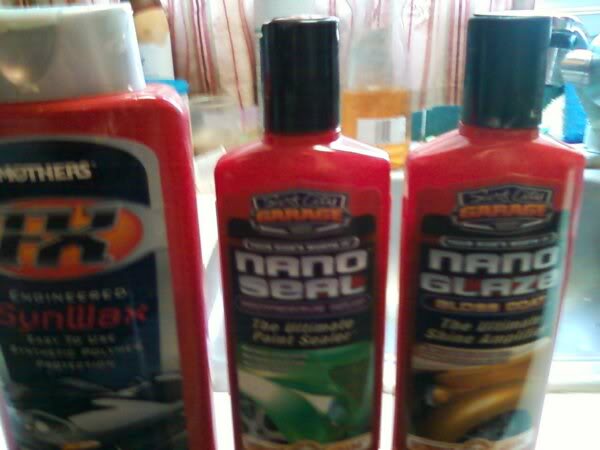
Do what "most" everyone here is saying, Clay,Cleaner,Synthetic but i would suggest doing a forth step.. Go to wally world or autozone or oreilly's and get a glaze.. That glaze on the last step will give the paint a real nice "wet" look. It doesnt last to long but it sure makes the paint pop.The bottle to the right i got at walmart. Very good stuff
Last edited by KingRanchCoy; Nov 11, 2012 at 12:29 PM.
Senior Member
Joined: Dec 1999
Posts: 1,372
Likes: 12
From: California
I seriously wish you would get with the modern times when it comes to detailing. You realize your posts about clay baring are pretty much the laughing stock on detailing forums don't you?
Show me something much more recent than a 10+ year old copied page of a service manual. Show me where Meguiar's smooth surface clay bar is rated at 3500 grit. Show me something where clay baring a vehicle even comes remotely close to resembling wet sanding it. I'll already assume you won't since you never seem to respond when questioned.
Yes, you are correct about claying only removing above surface defects, but no one ever said or claims for them to get below the clear coat.
Show me something much more recent than a 10+ year old copied page of a service manual. Show me where Meguiar's smooth surface clay bar is rated at 3500 grit. Show me something where clay baring a vehicle even comes remotely close to resembling wet sanding it. I'll already assume you won't since you never seem to respond when questioned.
Yes, you are correct about claying only removing above surface defects, but no one ever said or claims for them to get below the clear coat.
While I could post the most recent publication from Ford on this specific issued (dated Oct 2011), it does not have the pics the earlier publications have.....and since reading is fundamental, which you have on numerous occaisions failed to understand that these documents are not only published by the OEM's but the paint mfg's as well, I can only assume that pictures will be a greater learning experience as compared to the "shiny" PR materials you are use to looking at.
Now even if you use claybar for the purposes of removing contaminents from the paint....ok, since it (claybar) cannot remove a substance it cannot touch (laymans terms), how can it "majically" remove the contaminents from within the pores of the paint? Basic physics- it can't.
I'll be darn, just like the pictures show (grin).
oh so much for reading about science, physics & chemistry.............

Technical Article Contributor
Joined: Jun 2002
Posts: 10,511
Likes: 10
From: Under the flightpath of old ORD 22R
The last time you posted this BS I pointed out a search for it under the federal & state counts in Pacer showed no such case.
https://www.f150online.com/forums/4803644-post26.html
As per usual you went dead air on the topic. If the trade rags really are posting this, they have the reporting creditability of the Enquirer.
Stop passing this BS around, it is not true.
Senior Member
Joined: Sep 2011
Posts: 285
Likes: 0
From: Houghton, MI & Chicagoland
I wish you would catch up with the news....Megs was even "nailed" by the Federal Trade Commission in 2010 for making such claims as you are stating....well publicized in every trade publication that you can count....
While I could post the most recent publication from Ford on this specific issued (dated Oct 2011), it does not have the pics the earlier publications have.....and since reading is fundamental, which you have on numerous occaisions failed to understand that these documents are not only published by the OEM's but the paint mfg's as well, I can only assume that pictures will be a greater learning experience as compared to the "shiny" PR materials you are use to looking at.
Now even if you use claybar for the purposes of removing contaminents from the paint....ok, since it (claybar) cannot remove a substance it cannot touch (laymans terms), how can it "majically" remove the contaminents from within the pores of the paint? Basic physics- it can't.
I'll be darn, just like the pictures show (grin).
oh so much for reading about science, physics & chemistry.............
While I could post the most recent publication from Ford on this specific issued (dated Oct 2011), it does not have the pics the earlier publications have.....and since reading is fundamental, which you have on numerous occaisions failed to understand that these documents are not only published by the OEM's but the paint mfg's as well, I can only assume that pictures will be a greater learning experience as compared to the "shiny" PR materials you are use to looking at.
Now even if you use claybar for the purposes of removing contaminents from the paint....ok, since it (claybar) cannot remove a substance it cannot touch (laymans terms), how can it "majically" remove the contaminents from within the pores of the paint? Basic physics- it can't.
I'll be darn, just like the pictures show (grin).
oh so much for reading about science, physics & chemistry.............
Again, I never said a clay bar would remove contaminants below the surface, and neither do clay bar manufacturers. They remove above surface contaminants. Yes, the only true way to get the contaminants that remain below the surface is to use a paint decontamination system.
You comparing a clay bar to wet sanding is still BS though.
I'm done arguing about this. The "true" information is out there for those that care, and those who really want to know the truth.
Senior Member
Joined: Dec 1999
Posts: 1,372
Likes: 12
From: California
Not finding anything either on this so called "nailing" by the FTC either like SSCULLY.
Again, I never said a clay bar would remove contaminants below the surface, and neither do clay bar manufacturers. They remove above surface contaminants. Yes, the only true way to get the contaminants that remain below the surface is to use a paint decontamination system.
You comparing a clay bar to wet sanding is still BS though.
I'm done arguing about this. The "true" information is out there for those that care, and those who really want to know the truth.
Again, I never said a clay bar would remove contaminants below the surface, and neither do clay bar manufacturers. They remove above surface contaminants. Yes, the only true way to get the contaminants that remain below the surface is to use a paint decontamination system.
You comparing a clay bar to wet sanding is still BS though.
I'm done arguing about this. The "true" information is out there for those that care, and those who really want to know the truth.
so Meg's clay bar (they have 2), one is rated at 3500 grit and the other is 5,000 grit (per their spec sheets)
When you wet or dry sand a finished paint, the final grit rating is not less than 2000-2500....some like myself will take it one step farther and use 3000 grit.....so how much different is the abraisive level making the assumption that both are using water/soap/slip solution....we are only talking about 500 grit difference.....and as any painter will affirm, if you use 3000 grit (for example) dry, it's abraisiveness actually reduces (yes, the wet sanding actually increase the cutting because it does not allow/prevents paint particulates from sticking on the paper- and in essence allows the level of cutting to continue langer at a higher rate). Vists a auto body repair shop.....feel the difference between 2500 & 3000 grit, then feel your clay bar.....apply both to the surface of your hand, the most sensitive part, either wet or dry.....the difference is almost negligible.
Now as the pictures show, contaminents not only stick on the highest edges of a paints surface but rest in the pores, in essence, below the surface which the claybar does not touch and cannot remove, and this as you know gives 2 choices....either sand down to that level or chemically soften, dissolve, neutralize the residue, which realistically, is the only way to really do it without shortening the paints life-span. Clay bar possesses no chemicals to dissolve, neutralize any contaminent, so if it doesn't touch it, it can't remove it, the contaminent stays and ultimately creates sub-surface damage which shows up years later....in actuality, the damaged has not been corrected, but only partially removed and visually and by touch, "covered up"
If we look at contaminents in general, there are 2 types/categories...organic (natural) & inorganic (man-made).
Organics would include pollen, dust particulates, sap, bird droppings, etc.
Inorganics would include petroleum based products (carbon - automotive residues, kerosene type- aviation residue), industrial sourced...iron & oxides and chemical based- sulfer (smog), etc.
If you ask for and recieved the MSDS for claybar, it is comprised of no substance that will chemically soften, dissolve or neutralize any of the these. Basic chemistry simply applies...and as we all know that....
"Surfactants" will dissolve petroleum products (and surfactants by definition is soap...yes, dish soap)...unles you are dealing with a very thick product like tar, then we know that kerosene is the agent of choice (and is the actual ingredient in all "Bug & Tar Remover" products.
Vinegar handles most of the calcium based stains (acid rain) and
Alcohol will handle most of the industrial fallout elements......unless they have been baked in so to speak, then we need to use products specifically designed to soften, dissolve & neutralize.
ok, we have completed our basic chemistry & physics class for the day.....if you choose to not understand or accept basic scientific principles, that's fine, if you choose not accept every paint & oem mfg publications on paint correction, that's ok too, this is for those who are willing to learn and I encourage those to dig deeper and obtain the information to assess, correct and properly maintain your paint so it will last the 10 years the mfg's state that it will.
Last edited by beechkid; Nov 12, 2012 at 06:07 PM.
Technical Article Contributor
Joined: Jun 2002
Posts: 10,511
Likes: 10
From: Under the flightpath of old ORD 22R
#2 for the ignore the BS line you got caught passing around about the FTC and 3m/ Megs....
Don't know where you get this crap at, but stop it.