


PO401 & O2 switching


Thread Starter
|
Technical Article Contributor
Joined: Oct 2005
Posts: 25,641
Likes: 19
From: MI
PO401 & O2 switching
Is the front and downstream O2's interchangeable ?
I didn't think so - Two different Motorcraft part #'s...
Some third party vendors are selling the rears with the same part # as the front. ???
I was under the impression that the front and rear vary in responsibilities.
I have a set of old upstream O2's in the rear right now because the rears snapped off when trying to break them loose. I'm trying to figure out my options for replacement.
Also I keep getting a PO401 code. I ordered a new DPFE from Tomco - They are updated with that sensor. I haven't received it yet . I do not have rear Catalytic converters - I'm currently runny just front converters. Could that set up be part or all of the problem?
I was curious if my mismatched O2's had anything to do with the code as well ?
Throttle body and all passageways are clean and clear. All PCV and Vac Lines
have just been replaced.
The truck run great!! BUT , I keep getting the 401 code and I have a little vibration in idle smoothness as the RPMS are coming down to idle speed. Once @ idle (750 rpms) it's smooth..
SOOO - The DPFE is on the way. I haven't ordered O2's yet because I can get them cheap from a third party vendor, but all 4 have the SAME part #'s..??
I don't think that's right, what do you all think?
I know the DPFE A sensor monitors exhaust pressure changes above and below the metered orifice and converts the pressure into an analog signal, which is sent to the computer to compute optimum EGR flow, but that's just a part of computing the airflow correct? Well somethings off here..
I didn't think so - Two different Motorcraft part #'s...
Some third party vendors are selling the rears with the same part # as the front. ???
I was under the impression that the front and rear vary in responsibilities.
I have a set of old upstream O2's in the rear right now because the rears snapped off when trying to break them loose. I'm trying to figure out my options for replacement.
Also I keep getting a PO401 code. I ordered a new DPFE from Tomco - They are updated with that sensor. I haven't received it yet . I do not have rear Catalytic converters - I'm currently runny just front converters. Could that set up be part or all of the problem?
I was curious if my mismatched O2's had anything to do with the code as well ?
Throttle body and all passageways are clean and clear. All PCV and Vac Lines
have just been replaced.
The truck run great!! BUT , I keep getting the 401 code and I have a little vibration in idle smoothness as the RPMS are coming down to idle speed. Once @ idle (750 rpms) it's smooth..
SOOO - The DPFE is on the way. I haven't ordered O2's yet because I can get them cheap from a third party vendor, but all 4 have the SAME part #'s..??
I don't think that's right, what do you all think?
I know the DPFE A sensor monitors exhaust pressure changes above and below the metered orifice and converts the pressure into an analog signal, which is sent to the computer to compute optimum EGR flow, but that's just a part of computing the airflow correct? Well somethings off here..
Last edited by jbrew; Sep 4, 2007 at 06:20 PM.
Senior Member
Joined: Dec 2005
Posts: 2,426
Likes: 2
From: Lebanon,TN
Think the rear O2s main function is to check the health of the CAT. I had a fleet truck that keep giving me a IAT sensor code fault. I replaced the sensor 2xs along with good voltage and could not get it to go away. Finally took it to Ford to check and it had to be reflashed to correct the code.
Last edited by torkum; Sep 4, 2007 at 07:35 PM.

Senior Member

Joined: Oct 2002
Posts: 7,295
Likes: 125
From: St. Louis (Out in the woods)
The sensors themselves are the same. Only the connectors are different. The low-cost ones require your to splice the old connector onto the new sensor. There is no wide vs. narrow characteristic to be conscerned with. Don't bother replacing all four, the downstreams seldom fail. If you aren't thowing any codes related to them, there's no reason to change them.
As far as the P0401, you did do the suck test at idle, didn't you?
Steve
As far as the P0401, you did do the suck test at idle, didn't you?
Steve
Thread Starter
|
Technical Article Contributor
Joined: Oct 2005
Posts: 25,641
Likes: 19
From: MI
Originally Posted by projectSHO89
The sensors themselves are the same. Only the connectors are different. The low-cost ones require your to splice the old connector onto the new sensor. There is no wide vs. narrow characteristic to be conscerned with. Don't bother replacing all four, the downstreams seldom fail. If you aren't thowing any codes related to them, there's no reason to change them.
As far as the P0401, you did do the suck test at idle, didn't you?
Steve
As far as the P0401, you did do the suck test at idle, didn't you?
Steve
Well the rear O2 are now in two pieces - the both broke trying to remove. I had to cut them the rest of the way off, drop the exhaust to remove the rest .
I installed a old set of forward upstream O2's that I had handy - they plugged right in.
What are you saying , I have to switch the wires around? I know the white wires are designated for heat and connect to the ceramic core on both front and rear .. It must be the black and grey wires you talking about..?
Suck Test ? The O2's sucked!!! I pressure tested the lines if that's what you mean, they came with all the necessary rubber elbows and fit tight.. - Oh , the poppet valve? EGR ? No , didn't test the EGR - I have to read some literature I have here on how to test for a stuck valve - haven't had the pleasure yet.... - Remove and plug lol... No I havent tested that but there about a $100 everywhere I looked..
Last edited by jbrew; Sep 4, 2007 at 08:47 PM.
Thread Starter
|
Technical Article Contributor
Joined: Oct 2005
Posts: 25,641
Likes: 19
From: MI
Originally Posted by torkum
Think the rear O2s main function is to check the health of the CAT. I had a fleet truck that keep giving me a IAT sensor code fault. I replaced the sensor 2xs along with good voltage and could not get it to go away. Finally took it to Ford to check and it had to be reflashed to correct the code.
What year was that truck torkum?
Senior Member
Joined: Oct 2002
Posts: 7,295
Likes: 125
From: St. Louis (Out in the woods)
Well, I'm not surprised that replacing the O2 sensors twice didn't correct an IAT fault code...
Only the connectors on the O2 sensors are usually different. It's just a matter of cuttint the old connector off the old sensor and splicing it onto the new sensor's bare harness. Sometimes, it's just a matter of different length harnesses.
Suck test: Disconnect the vacuum line from the EGR valve. Substitute a length of rubber hose. Start engine and run at idle. Pretend the hose is a milkshake. If the engine stumbles or stalls, the EGR valve is working and the passages are minimally clear. If it doesn't change RPMs. the passages are likely blocked.
Steve
Only the connectors on the O2 sensors are usually different. It's just a matter of cuttint the old connector off the old sensor and splicing it onto the new sensor's bare harness. Sometimes, it's just a matter of different length harnesses.
Suck test: Disconnect the vacuum line from the EGR valve. Substitute a length of rubber hose. Start engine and run at idle. Pretend the hose is a milkshake. If the engine stumbles or stalls, the EGR valve is working and the passages are minimally clear. If it doesn't change RPMs. the passages are likely blocked.
Steve
Trending Topics
Thread Starter
|
Technical Article Contributor
Joined: Oct 2005
Posts: 25,641
Likes: 19
From: MI
Suck test done - Idle didn't fluctuate one bit. I even hooked up a fluid extracting gun (super sucker) and nothing, there still was no change in idle.
I pulled the EVR line - no change. Pulled the white EVAP - no change.
I figure hell , is anything working right ? I pull the big vac off the TB , well that did something , it almost quit before I could reconnect.
The passage ways in the EGR valve , the ones you can get at are clear and shiny just like the TB and elbow- there ported and polished.
I could have damaged the diaphragm when I cleaned w/compressed air I imagine. I have received a PO406 in the past which specifically points to the poppet valve - that was awhile ago, 6 months ago maybe.
The valve itself I had off about two weeks ago and was still operational by hand.
It's clean - trust that . I think the diaphragm has been compromised...
Can't you shove a rag underneath the EGR to test the diaphragm in some way? I heard of something like that in the past..
Just get a new one and leave the sh^t alone
I pulled the EVR line - no change. Pulled the white EVAP - no change.
I figure hell , is anything working right ? I pull the big vac off the TB , well that did something , it almost quit before I could reconnect.
The passage ways in the EGR valve , the ones you can get at are clear and shiny just like the TB and elbow- there ported and polished.
I could have damaged the diaphragm when I cleaned w/compressed air I imagine. I have received a PO406 in the past which specifically points to the poppet valve - that was awhile ago, 6 months ago maybe.
The valve itself I had off about two weeks ago and was still operational by hand.
It's clean - trust that . I think the diaphragm has been compromised...
Can't you shove a rag underneath the EGR to test the diaphragm in some way? I heard of something like that in the past..
Just get a new one and leave the sh^t alone
Last edited by jbrew; Sep 4, 2007 at 09:59 PM.
Senior Member
Joined: Dec 2005
Posts: 2,426
Likes: 2
From: Lebanon,TN
The truck was a '98 F150 with a 4.2 This TSB is realated to what Steve's suck test: 05-4-17 INTERMITTENT ROUGH IDLE - NON-COMMANDED EGR FLOW
Publication Date: February 21, 2005
FORD: 1997-1999 F-250 LD
1997-2004 F-150
1997-2005 E-Series
1998-2004 Expedition
1999-2004 F-Super Duty
2000-2005 Excursion
LINCOLN: 1998-1999 Navigator
ISSUE:
Some 1997-2005 5.4L 2V vehicles may exhibit an intermittent rough idle. This may be due to non-commanded EGR flow.
ACTION:
EGR flow can be detected by comparing the stabilized DPFEGR KOER voltage (from NGS/WDS) at idle after manually opening and closing the EGR valve through 8 cycles. Record the DPFEGR voltage after each cycle. If the DPFEGR voltage increases by 0.03V or more from the stabilized idle voltage and is associated with a rough idle, the valve should be replaced. Refer to the following Service Procedure.
SERVICE PROCEDURE
Connect NGS/WDS and monitor DPFEGR PID.
Record initial stabilized DPFEGR voltage.
Disconnect the EGR valve vacuum line and connect hand held vacuum pump.
Raise RPM to prevent stalling and fully open the EGR valve.
Fully close valve and return to idle.
Record stabilized DPFEGR voltage.
Repeat Steps 4-6, eight (8) times.
If voltage increases by 0.03V or more with an associated rough idle condition during any of the cycles, the EGR valve may be sticking. Lightly tap the EGR valve casting and observe if voltage returns to initial DPFEGR value.
If the DPFEGR voltage returns to the initial value and the associated rough idle is gone replace the EGR valve.
If there is no change in DPFEGR voltage do not replace the EGR valve and perform normal diagnostics.
If the EGR valve is replaced repeat Steps 3-6, two (2) times to verify fix.
PART NUMBER PART NAME
XL3Z-9D475-CA EGR Valve
WARRANTY STATUS:
Eligible Under Provisions Of New Vehicle Limited Warranty Coverage And Emissions Warranty Coverage
OPERATION DESCRIPTION TIME
050417A 1997-2005 Econoline 5.4L 2V: Replace The EGR Valve (Includes Time To Follow The Specific Diagnostic Steps Using WDS) (Do Not Use With 12650D, 12650D30) 0.9 Hr.
050417A 2000-2004 F250/350 5.4L 2V, 2000-2005 Excursion 5.4L 2V, 1998-1999 Navigator 5.4L 2V, 1998-2002 Expedition 5.4L 2V: Replace The EGR Valve (Includes Time To Follow The Specific Diagnostic Steps Using WDS) (Do Not Use With 12650D, 12650D30) 1.0 Hr.
050417A 1999 F250/F350 5.4L 2V, 1999-2004 F-150 5.4L 2V SC, 1997-2004 F-150 5.4L 2V, 2003-2004 Expedition 5.4L 2V: Replace The EGR Valve (Includes Time To Follow The Specific Diagnostic Steps Using WDS) (Do Not Use With 12650D, 12650D30) 1.1 Hrs.
DEALER CODING
BASIC PART NO. CONDITION CODE
9D475 55
--------------------------------------------------------------------------------
NOTE: The information in Technical Service Bulletins is intended for use by trained, professional technicians with the knowledge, tools, and equipment to do the job properly and safely. It informs these technicians of conditions that may occur on some vehicles, or provides information that could assist in proper vehicle service. The procedures should not be performed by "do-it-yourselfers". Do not assume that a condition described affects your car or truck. Contact a Ford, Lincoln, or Mercury dealership to determine whether the Bulletin applies to your vehicle. Warranty Policy and Extended Service Plan documentation determine Warranty and/or Extended Service Plan coverage unless stated otherwise in the TSB article. The information in this Technical Service Bulletin (TSB) was current at the time of printing. Ford Motor Company reserves the right to supercede this information with updates. The most recent information is available through Ford Motor Company's on-line technical resources.
Copyright © 2005 Ford Motor Company
Publication Date: February 21, 2005
FORD: 1997-1999 F-250 LD
1997-2004 F-150
1997-2005 E-Series
1998-2004 Expedition
1999-2004 F-Super Duty
2000-2005 Excursion
LINCOLN: 1998-1999 Navigator
ISSUE:
Some 1997-2005 5.4L 2V vehicles may exhibit an intermittent rough idle. This may be due to non-commanded EGR flow.
ACTION:
EGR flow can be detected by comparing the stabilized DPFEGR KOER voltage (from NGS/WDS) at idle after manually opening and closing the EGR valve through 8 cycles. Record the DPFEGR voltage after each cycle. If the DPFEGR voltage increases by 0.03V or more from the stabilized idle voltage and is associated with a rough idle, the valve should be replaced. Refer to the following Service Procedure.
SERVICE PROCEDURE
Connect NGS/WDS and monitor DPFEGR PID.
Record initial stabilized DPFEGR voltage.
Disconnect the EGR valve vacuum line and connect hand held vacuum pump.
Raise RPM to prevent stalling and fully open the EGR valve.
Fully close valve and return to idle.
Record stabilized DPFEGR voltage.
Repeat Steps 4-6, eight (8) times.
If voltage increases by 0.03V or more with an associated rough idle condition during any of the cycles, the EGR valve may be sticking. Lightly tap the EGR valve casting and observe if voltage returns to initial DPFEGR value.
If the DPFEGR voltage returns to the initial value and the associated rough idle is gone replace the EGR valve.
If there is no change in DPFEGR voltage do not replace the EGR valve and perform normal diagnostics.
If the EGR valve is replaced repeat Steps 3-6, two (2) times to verify fix.
PART NUMBER PART NAME
XL3Z-9D475-CA EGR Valve
WARRANTY STATUS:
Eligible Under Provisions Of New Vehicle Limited Warranty Coverage And Emissions Warranty Coverage
OPERATION DESCRIPTION TIME
050417A 1997-2005 Econoline 5.4L 2V: Replace The EGR Valve (Includes Time To Follow The Specific Diagnostic Steps Using WDS) (Do Not Use With 12650D, 12650D30) 0.9 Hr.
050417A 2000-2004 F250/350 5.4L 2V, 2000-2005 Excursion 5.4L 2V, 1998-1999 Navigator 5.4L 2V, 1998-2002 Expedition 5.4L 2V: Replace The EGR Valve (Includes Time To Follow The Specific Diagnostic Steps Using WDS) (Do Not Use With 12650D, 12650D30) 1.0 Hr.
050417A 1999 F250/F350 5.4L 2V, 1999-2004 F-150 5.4L 2V SC, 1997-2004 F-150 5.4L 2V, 2003-2004 Expedition 5.4L 2V: Replace The EGR Valve (Includes Time To Follow The Specific Diagnostic Steps Using WDS) (Do Not Use With 12650D, 12650D30) 1.1 Hrs.
DEALER CODING
BASIC PART NO. CONDITION CODE
9D475 55
--------------------------------------------------------------------------------
NOTE: The information in Technical Service Bulletins is intended for use by trained, professional technicians with the knowledge, tools, and equipment to do the job properly and safely. It informs these technicians of conditions that may occur on some vehicles, or provides information that could assist in proper vehicle service. The procedures should not be performed by "do-it-yourselfers". Do not assume that a condition described affects your car or truck. Contact a Ford, Lincoln, or Mercury dealership to determine whether the Bulletin applies to your vehicle. Warranty Policy and Extended Service Plan documentation determine Warranty and/or Extended Service Plan coverage unless stated otherwise in the TSB article. The information in this Technical Service Bulletin (TSB) was current at the time of printing. Ford Motor Company reserves the right to supercede this information with updates. The most recent information is available through Ford Motor Company's on-line technical resources.
Copyright © 2005 Ford Motor Company
Last edited by torkum; Sep 4, 2007 at 10:21 PM.
Senior Member
Joined: Dec 2005
Posts: 2,426
Likes: 2
From: Lebanon,TN
Steve, the sensor I replaced 2xs was the IAT sensor, not a O2 sensor. I had correct voltage to the IAT sensor and still got the code after each drive cycle. The reason I replaced the sensor 2xs was to make sure the first 1 wasn't bad. After checking all that was recommended I took the truck to the dealership for a reflash for the repeated IAT fault code.
Thread Starter
|
Technical Article Contributor
Joined: Oct 2005
Posts: 25,641
Likes: 19
From: MI
So my valve is stuck shut..To bad you cant apply pressure to unstick it..
I have to say , my truck idles perfectly - no stumble or surge - right there at 750 and steady..
I running my stock cold air intake w/K&N drop in, and a 4" cold air inlet..
COPs are newer. My sensors are old - most are stock lol. Looks like I better just replace them all, freakin hate it when I no something wrong with it..
I have to say , my truck idles perfectly - no stumble or surge - right there at 750 and steady..
I running my stock cold air intake w/K&N drop in, and a 4" cold air inlet..
COPs are newer. My sensors are old - most are stock lol. Looks like I better just replace them all, freakin hate it when I no something wrong with it..
Thread Starter
|
Technical Article Contributor
Joined: Oct 2005
Posts: 25,641
Likes: 19
From: MI
Something else that has changed recently. After shutting the motor down the EVR always made noises while air was bleeding off. It has done that for couple years or longer. I hear that's pretty normal. Well, it doesn't make a peep now and no air bleeds off.
I'm kinda thinking that stopped making noises about the same time I started getting PO401, PO402 and PO406 codes in the last couple months. Usually 401, the others happened only once at different times.
Well the DPFE will be here in a couple days - I guess I'll see if Auto Zone or Carquest has the EGR valve in stock..
EVR's don't usually go out do they?
I'm kinda thinking that stopped making noises about the same time I started getting PO401, PO402 and PO406 codes in the last couple months. Usually 401, the others happened only once at different times.
Well the DPFE will be here in a couple days - I guess I'll see if Auto Zone or Carquest has the EGR valve in stock..
EVR's don't usually go out do they?
Last edited by jbrew; Sep 4, 2007 at 11:06 PM.

Senior Member
Joined: Jan 2005
Posts: 5,389
Likes: 0
From: Fort Worth,Tx
Originally Posted by jbrew
Something else that has changed recently. After shutting the motor down the EVR always made noises while air was bleeding off. It has done that for couple years or longer. I hear that's pretty normal. Well, it doesn't make a peep now and no air bleeds off.
I'm kinda thinking that stopped making noises about the same time I started getting PO401, PO402 and PO406 codes in the last couple months. Usually 401, the others happened only once at different times.
Well the DPFE will be here in a couple days - I guess I'll see if Auto Zone or Carquest has the EGR valve in stock..
EVR's don't usually go out do they?
I'm kinda thinking that stopped making noises about the same time I started getting PO401, PO402 and PO406 codes in the last couple months. Usually 401, the others happened only once at different times.
Well the DPFE will be here in a couple days - I guess I'll see if Auto Zone or Carquest has the EGR valve in stock..
EVR's don't usually go out do they?
hey i still got that EGR valve if u want it!! lol dont go buy one
Thread Starter
|
Technical Article Contributor
Joined: Oct 2005
Posts: 25,641
Likes: 19
From: MI
Yea , I need it . It's totally different than the 4.6 EGR tho - I have one of those.
Do you have one like this ?- The 4.6L EGR has the blue vac plug on top. The 5.4L EGR has the red plug cap on top -
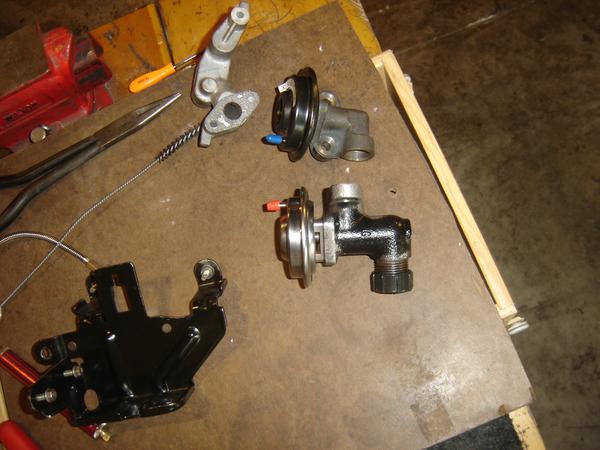
Do you have one like this ?- The 4.6L EGR has the blue vac plug on top. The 5.4L EGR has the red plug cap on top -
Last edited by jbrew; Sep 4, 2007 at 11:52 PM.

