


Low vacuum problem with a 4.6...


Thread Starter
|
Junior Member
Joined: Jun 2009
Posts: 6
Likes: 0
Low vacuum problem with a 4.6...
Okay, this is gonna take a bit to explain, but I'm gonna try my best.
Fixing a truck for a customer. I know my way around a vehicle, but it's been awhile since I've done major engine work (probably a good two years or so).
That being said, my customer brought me a 1997 F-150 with a 4.6 in it, tells me it needs a head gasket.
I verify and yep, she's definitely cooking coolant among other things, looks like a head gasket. Pull her apart, send the heads out to get machined, get it back together. I heavily marked the timing chain and guides in several spots that way I could get the timing aligned correct. My understanding is that with a 4.6, it's an interference fit, so if I was off at all, I'd be hitting valves. After everything went back together, I used a ratchet and turned it over by hand a couple of times. Nothing seemed to be binding.
As far as I remember, the following is what I replaced...
- cooling fan clutch - bearings were wiped
- injector - #8 cylinder injector clearly wasn't original. Looks like they lost the original or it went bad, and they pulled this one from a scrap yard. Really ****ty condition too. Later we found the original injector tucked under part of the frame.
- altenator - took a dump on me while test driving it. I had already told the customer it was done too....
- head gasket - got a place to service the heads, they machined them and replaced the valve seals.
- serp belt - belt was cracking pretty bad.
I start her up, and she's running decent. Pulled an O2 code, talked to the customer, and replaced that too. Took it for a spin, get back, and I hear a "ticking" sound coming from the right front. The customer is pretty handy, and with his help, we track the problem down to two hydraulic lifters. Was able to replace them without removing the heads.
Customer picks the truck up, drives it for a good portion of the weekend, and about 250 miles in, something takes a dump. She's running rough.
Somewhere in all this, the other side lifters start making noise too. Talked to the customer and instead of replacing a couple, I do the whole side.
We're talking and he suspects the timing might be off. It's pulling between 5 and 10 inches of vacuum and bouncing back and forth rapidly. Sounds like it's missing something fierce.
I like to make sure my customers are happy, so I take two days and pull it back apart, pull off the timing covers, pull the timing chains physically off the vehicle, and match the links. I wanted to make sure that if I was going to go through all that, this bastard was gonna be right this time. Also finished the first side's lifters. Now all the lifters in the top end are brand new.
Wouldn't you know, the f*cker is still pulling only between 5 and 10 inches of vacuum and still bouncing? I went ahead and pulled the O2 sensors, thinking that it might have been a backpressure issue. This vehicle has dual exhaust, so there is a catalytic converter on each side. I was wondering if they might be getting clogged and had read that if the cats do clog, the issue of running rough is there along with no vacuum.
Also read it might be just a massive vacuum leak. So I douse the topend with carb clean trying to find a leak. Originally found the EGR leaking at the gasket, and replaced the gasket, but nothing changed.
I've checked the EGR and related components, and physically pulled the EGR myself to make sure it wasn't leaking. It's working just fine. Also checked related components, got a new IAC valve and swapped it, and checked the voltage coming back from the MAF. Everything seems to check out. Finally, it occurred to me that there might be a vacuum leak on the intake and I just can't hit it with carb clean, so I pull the intake again. Split the upper and lower plenum and clean and replace all gaskets. At this point I'm RTVing the crap outta it cause I want to make sure I only do this once.
Nothing. Nada. Zilch. Still doing it.
Much more of this and I'm gonna drive this truck off of a cliff. Point me in the right direction, please.
Fixing a truck for a customer. I know my way around a vehicle, but it's been awhile since I've done major engine work (probably a good two years or so).
That being said, my customer brought me a 1997 F-150 with a 4.6 in it, tells me it needs a head gasket.
I verify and yep, she's definitely cooking coolant among other things, looks like a head gasket. Pull her apart, send the heads out to get machined, get it back together. I heavily marked the timing chain and guides in several spots that way I could get the timing aligned correct. My understanding is that with a 4.6, it's an interference fit, so if I was off at all, I'd be hitting valves. After everything went back together, I used a ratchet and turned it over by hand a couple of times. Nothing seemed to be binding.
As far as I remember, the following is what I replaced...
- cooling fan clutch - bearings were wiped
- injector - #8 cylinder injector clearly wasn't original. Looks like they lost the original or it went bad, and they pulled this one from a scrap yard. Really ****ty condition too. Later we found the original injector tucked under part of the frame.
- altenator - took a dump on me while test driving it. I had already told the customer it was done too....
- head gasket - got a place to service the heads, they machined them and replaced the valve seals.
- serp belt - belt was cracking pretty bad.
I start her up, and she's running decent. Pulled an O2 code, talked to the customer, and replaced that too. Took it for a spin, get back, and I hear a "ticking" sound coming from the right front. The customer is pretty handy, and with his help, we track the problem down to two hydraulic lifters. Was able to replace them without removing the heads.
Customer picks the truck up, drives it for a good portion of the weekend, and about 250 miles in, something takes a dump. She's running rough.
Somewhere in all this, the other side lifters start making noise too. Talked to the customer and instead of replacing a couple, I do the whole side.
We're talking and he suspects the timing might be off. It's pulling between 5 and 10 inches of vacuum and bouncing back and forth rapidly. Sounds like it's missing something fierce.
I like to make sure my customers are happy, so I take two days and pull it back apart, pull off the timing covers, pull the timing chains physically off the vehicle, and match the links. I wanted to make sure that if I was going to go through all that, this bastard was gonna be right this time. Also finished the first side's lifters. Now all the lifters in the top end are brand new.
Wouldn't you know, the f*cker is still pulling only between 5 and 10 inches of vacuum and still bouncing? I went ahead and pulled the O2 sensors, thinking that it might have been a backpressure issue. This vehicle has dual exhaust, so there is a catalytic converter on each side. I was wondering if they might be getting clogged and had read that if the cats do clog, the issue of running rough is there along with no vacuum.
Also read it might be just a massive vacuum leak. So I douse the topend with carb clean trying to find a leak. Originally found the EGR leaking at the gasket, and replaced the gasket, but nothing changed.
I've checked the EGR and related components, and physically pulled the EGR myself to make sure it wasn't leaking. It's working just fine. Also checked related components, got a new IAC valve and swapped it, and checked the voltage coming back from the MAF. Everything seems to check out. Finally, it occurred to me that there might be a vacuum leak on the intake and I just can't hit it with carb clean, so I pull the intake again. Split the upper and lower plenum and clean and replace all gaskets. At this point I'm RTVing the crap outta it cause I want to make sure I only do this once.
Nothing. Nada. Zilch. Still doing it.
Much more of this and I'm gonna drive this truck off of a cliff. Point me in the right direction, please.
Last edited by musicalmechanic; Jun 21, 2009 at 04:52 PM.
Senior Member


Joined: Dec 2006
Posts: 43,531
Likes: 817
From: Joplin MO
Check the PCV system - the hoses do rot and cause vacuum leaks, especially the elbow at the back of the intake. You can get a complete replacement including hard lines from Ford for about 30 bucks. Only use a Motorcraft PCV valve.
Is it throwing any codes now?
Is it throwing any codes now?
Thread Starter
|
Junior Member
Joined: Jun 2009
Posts: 6
Likes: 0
Bank 2 lean code. Only thing that comes up.
I pulled the PVC valve and I'm getting suction through it. I hear a drop in RPM (if I remember correct) when I pull it out of the valve cover, my guess is because I'm no longer sucking case vent but bringing air directly from atmosphere, leaning out the mix even further.
I started pulling fuel injector leads to see if I could isolate the problem to which cylinders. It seems like the only ones I hear a significant drop in RPM on are cylinders 1, 4, 5, and 8 (I'm going from memory here, as I did the test yesterday), which isn't consistant with a coil shot, as I remember two of the cylinders are on one, and two cylinders are on the other coil. Cylinder 1 is not a significant drop, but it does seem like it's there. The others seem like they are causing no drop.
Got two P0174 codes, but no miss code.
http://www.obd-codes.com/p0174
Thanks for the advice btw.
I pulled the PVC valve and I'm getting suction through it. I hear a drop in RPM (if I remember correct) when I pull it out of the valve cover, my guess is because I'm no longer sucking case vent but bringing air directly from atmosphere, leaning out the mix even further.
I started pulling fuel injector leads to see if I could isolate the problem to which cylinders. It seems like the only ones I hear a significant drop in RPM on are cylinders 1, 4, 5, and 8 (I'm going from memory here, as I did the test yesterday), which isn't consistant with a coil shot, as I remember two of the cylinders are on one, and two cylinders are on the other coil. Cylinder 1 is not a significant drop, but it does seem like it's there. The others seem like they are causing no drop.
Got two P0174 codes, but no miss code.
http://www.obd-codes.com/p0174
Thanks for the advice btw.
Thread Starter
|
Junior Member
Joined: Jun 2009
Posts: 6
Likes: 0
Wires and plugs are brand new.
I think AC Delco, but I'd have to check. I checked the gap and the gap was in spec. I really don't think this is my issue, I put an in-line spark tester at the coil pack and got signal to several of the cylinders that weren't firing. I'll be honest and admit I didn't check them all, probably checked three that weren't firing, if I remember correct.
Also checked the resistance of the injectors. Right in spec.
When you say physically inspect the PVC elbow, I think I did. I pulled it while the vehicle was running and could hear suction through it. I pulled it with the vehicle off and rattled it, and it did what it was supposed to. We also hit it several times with carb clean to make sure it wasn't sucking air and it's most definitely air tight.
At this point I'm thinking that a sensor is bad and leaning out the fuel mix something fierce. The idle evens out when I spray carb clean in a vacuum line, telling me that I'm getting spark to the cylinders. I just can't figure out what. I'm damned near positive it's not a vacuum leak, I think it's flat out missing, which is causing the vacuum to drop hardcore. The rapid fluctuation between 5 and 10 psi vacuum tells me that the cylinders aren't firing consistent, and therefore not pulling enough volume. Either that, or I'm drawing in a tremendous amount of air from another source, so the intake doesn't need as much volume, therefore decreasing vacuum.
I might want to see about spraying starting fluid or something in at a pretty constant short burst to see if the vacuum does rise, might be a good idea. If it is a fuel supply problem, and I supplement the fuel supply with starting fluid, I should therefore get a much higher rise in vacuum, as those cylinders that are being deprived are now being supplied...
I think AC Delco, but I'd have to check. I checked the gap and the gap was in spec. I really don't think this is my issue, I put an in-line spark tester at the coil pack and got signal to several of the cylinders that weren't firing. I'll be honest and admit I didn't check them all, probably checked three that weren't firing, if I remember correct.
Also checked the resistance of the injectors. Right in spec.
When you say physically inspect the PVC elbow, I think I did. I pulled it while the vehicle was running and could hear suction through it. I pulled it with the vehicle off and rattled it, and it did what it was supposed to. We also hit it several times with carb clean to make sure it wasn't sucking air and it's most definitely air tight.
At this point I'm thinking that a sensor is bad and leaning out the fuel mix something fierce. The idle evens out when I spray carb clean in a vacuum line, telling me that I'm getting spark to the cylinders. I just can't figure out what. I'm damned near positive it's not a vacuum leak, I think it's flat out missing, which is causing the vacuum to drop hardcore. The rapid fluctuation between 5 and 10 psi vacuum tells me that the cylinders aren't firing consistent, and therefore not pulling enough volume. Either that, or I'm drawing in a tremendous amount of air from another source, so the intake doesn't need as much volume, therefore decreasing vacuum.
I might want to see about spraying starting fluid or something in at a pretty constant short burst to see if the vacuum does rise, might be a good idea. If it is a fuel supply problem, and I supplement the fuel supply with starting fluid, I should therefore get a much higher rise in vacuum, as those cylinders that are being deprived are now being supplied...
Last edited by musicalmechanic; Jun 21, 2009 at 08:23 PM.

Senior Member
Joined: Nov 2007
Posts: 3,271
Likes: 0
From: whaleyville, MD
Wires and plugs are brand new.
I think AC Delco, but I'd have to check. I checked the gap and the gap was in spec. I really don't think this is my issue, I put an in-line spark tester at the coil pack and got signal to several of the cylinders that weren't firing. I'll be honest and admit I didn't check them all, probably checked three that weren't firing, if I remember correct.
I think AC Delco, but I'd have to check. I checked the gap and the gap was in spec. I really don't think this is my issue, I put an in-line spark tester at the coil pack and got signal to several of the cylinders that weren't firing. I'll be honest and admit I didn't check them all, probably checked three that weren't firing, if I remember correct.
When you say physically inspect the PVC elbow, I think I did. I pulled it while the vehicle was running and could hear suction through it. I pulled it with the vehicle off and rattled it, and it did what it was supposed to. We also hit it several times with carb clean to make sure it wasn't sucking air and it's most definitely air tight.
At this point I'm thinking that a sensor is bad and leaning out the fuel mix something fierce. The idle evens out when I spray carb clean in a vacuum line, telling me that I'm getting spark to the cylinders. I just can't figure out what. I'm damned near positive it's not a vacuum leak, I think it's flat out missing, which is causing the vacuum to drop hardcore. The rapid fluctuation between 5 and 10 psi vacuum tells me that the cylinders aren't firing consistent, and therefore not pulling enough volume. Either that, or I'm drawing in a tremendous amount of air from another source, so the intake doesn't need as much volume, therefore decreasing vacuum.
this may help
http://www.v8sho.com/SHO/TSB0197HO2SServiceTips.htm
Trending Topics
Thread Starter
|
Junior Member
Joined: Jun 2009
Posts: 6
Likes: 0
thats one problem. the modular engines are very picky about there spark plugs. motorcraft, denso, and ngk plugs are the only ones so far proven to work well. all other plugs are kinda iffy. sometimes they work and sometimes they dont.
A bit later, I'll climb back under the hood and pop out #4 plug, swap it with #1, start it up, and pull the injector lead for #1. If I feel a significant drop in RPM, that would point toward a shift from #4 cylinder to #1 cylinder. Worth a shot at least.
please dont use anymore carb cleaner. it melts plastic. did you check the back of the intake? did you feel around back there? the elbow is the most common cause of lean codes in fords.
Yeah, I felt around back there quite a bit, and we hit it with cleaner quite a bit too. I would think that if there was a leak back there, we would have hit it pretty good.
I'm guessing I can pull that line back there and plug it, and if the vacuum picks up pretty good, I'd isolate it pretty quick. I've done that with some of the other lines (like the one that comes off of the right side of the intake for the EGR circuit) but not to the one at the back of the intake.
what is the fuel pressure? its only lean in bank 2 right? kinda points me towards bad intake gaskets for the driver side bank. maybe even a cracked intake.
Got a question for you. I just remembered reading that you should be able to pull the vacuum line from the regulator, and see about a 10 PSI jump in fuel pressure. We do not, but we were thinking that might be because of such a low vacuum in general. What is the purpose of vacuum at the regulator and what happens that causes that jump in fuel pressure.
I'll toss a gauge back on it tomorrow to see if the pressure has changed.
And seriously, thanks for any advice. I used to have the same truck and loved it, kinda hated getting rid of it. But this job has me thinking that the truck doesn't like me too much. Just to give you an idea of how much the truck doesn't like me, I put the intake back together, tightening the very last bolt on the left side (driver's side) and dropped my 10 MM socket between the engine housing and the lower plenum. Had to pull the damn intake off again to get to it. It's a snap-on socket and I don't talk to a dealer anymore, so you know how it goes...

Senior Member
Joined: Sep 2007
Posts: 1,512
Likes: 1
From: >wwOwww<
X3 on the vacuum line to the back of the manifold. Sometimes, that connector will make you feel like an idiot. Just trace out the line from the PCV, around the Valve cover completely to the other end. That is where the problem usually is.

Technical Article Contributor
Joined: Oct 2005
Posts: 25,641
Likes: 19
From: MI
I'll hit a few things.
Carb cleaner - Major bad on these. Kills sensors/ Eats everything but metal. Diaphragms,o-rings, chaff's wire to degree of short, seals etc... Knowing that alone I would have to go thru everything on top.
PCV- I'm not convinced this was checked properly. The wrong one is most likley being used. Spec margins only exist in the Motorcraft valves. Regardless, the system needs checking - The entire PCV system.
Plugs - Ieeyiyiiiii lol. Get ~ Motorcraft .
Did I hear Permatex or something on the intake gaskets? That's a leaker for sure, -if not now, in the near future.
$19 for one of these, would have paid itself off very fast on this one -

Carb cleaner - Major bad on these. Kills sensors/ Eats everything but metal. Diaphragms,o-rings, chaff's wire to degree of short, seals etc... Knowing that alone I would have to go thru everything on top.
PCV- I'm not convinced this was checked properly. The wrong one is most likley being used. Spec margins only exist in the Motorcraft valves. Regardless, the system needs checking - The entire PCV system.
Plugs - Ieeyiyiiiii lol. Get ~ Motorcraft .
Did I hear Permatex or something on the intake gaskets? That's a leaker for sure, -if not now, in the near future.
$19 for one of these, would have paid itself off very fast on this one -
Thread Starter
|
Junior Member
Joined: Jun 2009
Posts: 6
Likes: 0
X3 on the vacuum line to the back of the manifold. Sometimes, that connector will make you feel like an idiot. Just trace out the line from the PCV, around the Valve cover completely to the other end. That is where the problem usually is.
Carb cleaner - Major bad on these. Kills sensors/ Eats everything but metal. Diaphragms,o-rings, chaff's wire to degree of short, seals etc... Knowing that alone I would have to go thru everything on top.
PCV- I'm not convinced this was checked properly. The wrong one is most likley being used. Spec margins only exist in the Motorcraft valves. Regardless, the system needs checking - The entire PCV system.
Plugs - Ieeyiyiiiii lol. Get ~ Motorcraft
Did I hear Permatex or something on the intake gaskets? That's a leaker for sure, -if not now, in the near future.
$19 for one of these, would have paid itself off very fast on this one -
-------------------------------------------------------
Does anyone know if a bad fuel pressure regulator will seriously affect vacuum. As far as I can tell, they only really fail by letting fuel into the intake via the vacuum hose, which would create a "run rich" condition. Nothing seems to change, no change in fuel pressure nor rpm when the vacuum hose at the regulator is disconnected. I suspect that's due to such a low vacuum to begin with though, and it's probably not affecting the regulator too much. But if that was the case, shouldn't the fuel pressure be sitting close to 50 PSI, not at the 40 it currently is?
Technical Article Contributor
Joined: Oct 2005
Posts: 25,641
Likes: 19
From: MI
When the outcome of work done has little to know effect, most get discouraged and more less give up; - specially after attempting to fix it a few different times. Turns into, -what can I do or say, just to get the damn thing out of the garage lol.
Your not that way though, that's respectable/ admirable IMO.
So ask away, I'll share what I know. What would help most? I have the 97 4.6L Ford Service DVD loaded on the computer next to me (Timing procedure?)
For leaks I use a 3' section of hose (1/4") w/ Mapp Gas and 3/16 Brake hard-line - WD40, Mineral Spirits, Windex, Dish soap. BUT!! Keep EVERTHING away from the EGR valve. You can compromise the diaphragm real easy w/cleaners. It's best to test that with a section of hose and a Mighty Vac. In fact, use the Mighty Vac to test Vac harness and even the PCV assemblies.
The PCV system connects to the manifold or throttle body elbow back by the firewall, here-
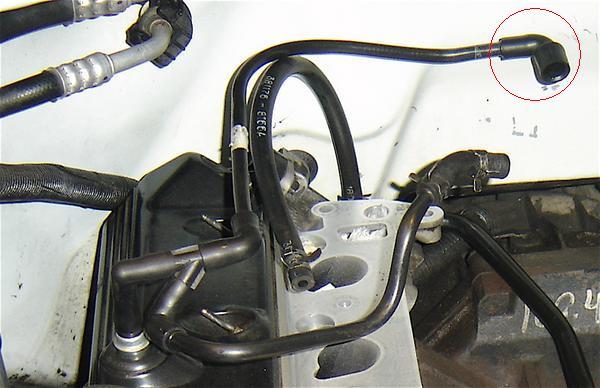
What usually goes bad is circled ^^^^^
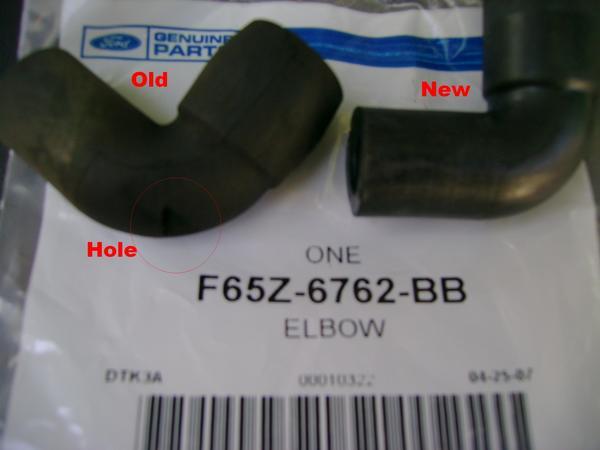
Yea, holes can develop here ^^^^^
Where do you want to start?
Most likley, you have Autolite Plugs in their. - If so , those must go.
There's quite a few others here (good guys) that will help as well, infact you already have them helping you up ^^^ there ...
Your not that way though, that's respectable/ admirable IMO.
So ask away, I'll share what I know. What would help most? I have the 97 4.6L Ford Service DVD loaded on the computer next to me (Timing procedure?)
For leaks I use a 3' section of hose (1/4") w/ Mapp Gas and 3/16 Brake hard-line - WD40, Mineral Spirits, Windex, Dish soap. BUT!! Keep EVERTHING away from the EGR valve. You can compromise the diaphragm real easy w/cleaners. It's best to test that with a section of hose and a Mighty Vac. In fact, use the Mighty Vac to test Vac harness and even the PCV assemblies.
The PCV system connects to the manifold or throttle body elbow back by the firewall, here-
What usually goes bad is circled ^^^^^
Yea, holes can develop here ^^^^^
Where do you want to start?
Most likley, you have Autolite Plugs in their. - If so , those must go.
There's quite a few others here (good guys) that will help as well, infact you already have them helping you up ^^^ there ...
Last edited by jbrew; Jun 21, 2009 at 11:33 PM. Reason: still editing, more stuff coming
Thread Starter
|
Junior Member
Joined: Jun 2009
Posts: 6
Likes: 0
When the outcome of work done has little to know effect, most get discouraged and more less give up; - specially after attempting to fix it a few different times. Turns into, -what can I do or say, just to get the damn thing out of the garage lol.
We both, more or less, decided that if, and since, I can't figure it out, it might have to go to a shop with some more diagnostic capabilities. But I hate that concept, and would really love to figure this out before he takes the truck back. So, here I am bugging you guys.

So ask away, I'll share what I know. What would help most? I have the 97 4.6L Ford Service DVD loaded on the computer next to me (Timing procedure?)
We learn something new every day, haha.
For leaks I use a 3' section of hose (1/4") w/ Mapp Gas and 3/16 Brake hard-line - WD40, Mineral Spirits, Windex, Dish soap. BUT!! Keep EVERTHING away from the EGR valve. You can compromise the diaphragm real easy w/cleaners. It's best to test that with a section of hose and a Mighty Vac. In fact, use the Mighty Vac to test Vac harness and even the PCV assemblies.
I'll have to finally break down and pick up a mighty vac. Been meaning to get one for years. I think the local Harbor Freight (surprisingly enough) sells them for a decent price.
As far as the pics you sent, our PVC system looks different. What your showing would be considered the right side (or passenger side) of the engine. Coming up behind the mainfold, there is no elbow on the truck I'm working on, it simply goes from the plastic line to a straight rubber hose that connects to the manifold. The plastic line is formed, looks almost like a "u" and has a bend in it that brings it in-line with the nipple on the manifold.
So, I'm thinking two things. First. I can "cap off" that line, isolating the vacuum draw from the PVC valve entirely, taking it out of the equation. If the vacuum loss is due to that part of the circuit, I would immediately see a spike in vacuum. Even if it running rough, I could do it temporarily and see some type of volume change on the vacuum gauge, which I have not been able to do up to this point. It's a direction for me to at least go in, anyways.
Second. I have some concerns about the fuel pressure. If the fuel regulator is not operation correct, how does that affect fuel pressure? In my situation, the fuel pressure sits around 40 PSI with the regulator both plugged to vacuum and unplugged. If I understand the operation of that circuit right, the pressure should spike 10 PSI to 50 PSI with the vacuum line disconnected.
I'm receiving very low vacuum, shouldn't the pressure be at least a little above the normal range of 40? And when I disconnected the vacuum line, and no change occurred, doesn't that mean that my fuel pressure unregulated is sitting at 10 PSI lower then it should be? As in, if I had adequate vacuum, my fuel pressure would be lower then 40, probably around 30 or so.
I wonder if my problem is not a air ratio problem, but a fuel supply problem. The "run lean" code might be a bit more literal, as in, the truck just can't get enough fuel, period. I'm still not sure how that affects volume of vacuum, though. If the truck is missing, will it have such a literal effect on vacuum? As in, when I'm idling rough at 700 RPM, the cylinders are still drawing in air to provide for the non-firing cylinders, which seems like it would register a higher volume then 5 - 10 inches.

Senior Member
Joined: Oct 2003
Posts: 4,920
Likes: 5
From: Washington
that elbow he has a picture of, look closely, its dry rotted in the middle of the bend and is very common.
I personally would overlook the sparkplugs (assuming you've gapped them properly and used some dielectic compound as safeguard) since you should really only notice intermittent "low grade" misfire with the off brand plugs this soon after.
I will say one thing i did not notice anyone check out or mention yet with the 97, the coil packs have an ohm load you can test for, however i cant tell you specifics. i do recall its suppose to be several hundred meg ohms from primary to secondary which if i remember from er last year, was the middle to either outside pins on the connector, or middle pin to each coil.
i think your logic on the regulator is correct too, you should see a visual difference in psi when the vac is disconnected. i remember my dad had a problem with the earlier body style, the regulator basically rotted out and leaked by, flooding the engine.
I personally would overlook the sparkplugs (assuming you've gapped them properly and used some dielectic compound as safeguard) since you should really only notice intermittent "low grade" misfire with the off brand plugs this soon after.
I will say one thing i did not notice anyone check out or mention yet with the 97, the coil packs have an ohm load you can test for, however i cant tell you specifics. i do recall its suppose to be several hundred meg ohms from primary to secondary which if i remember from er last year, was the middle to either outside pins on the connector, or middle pin to each coil.
i think your logic on the regulator is correct too, you should see a visual difference in psi when the vac is disconnected. i remember my dad had a problem with the earlier body style, the regulator basically rotted out and leaked by, flooding the engine.

Technical Article Contributor

Joined: Dec 1997
Posts: 9,417
Likes: 11
From: Windsor,Ontario,Canada
Are you sure there are no leaks between the MAF and the throttle body? That includes the hoses from the IAC and the driver side valve cover. If the valve covers are leaking that will produce a vacuum leak.
.
.