


Got My Upgraded Ticket


Senior Member
Joined: Aug 2005
Posts: 4,813
Likes: 0
From: Aurora Texas

The reason why an amateur radio operator is called a 'ham' is not known. Some relate these three letters (HAM) to the names of three great radio experimenters. They are- Hertz (who practically demonstrated the existence of electromagnetic waves in 1888), Armstrong (who developed a resonant oscillator circuit for radio frequency work) and Marconi (the 1909 Nobel laureate in Physics, who in the year 1901 established the first transatlantic radio contact).
Some people believe that when the young and inexperienced radio enthusiasts began to venture on air with crude spark transmitters based on vehicle ignition coils, their Morse code transmission must have been pretty poor and professionals dismissed them as 'ham fisted'!
While others have their own version; according to them during the earlier days of radio communication, government stepped in to conquer short-waves and allowed the radio amateurs to operate only on certain frequencies; thus the frequencies of amateur radio stations were sandwiched like a 'ham sandwich' and so amateur radio operator came to be called a 'ham'.
Another speculation is that the word "HAM" stands for " Help All Mankind" as reflected in its service towards people in distress during natural calamities, disasters and civil emergencies!
Well, it goes like this:
The word "HAM" as applied to 1908 was the station CALL of the first amateur wireless station operated by some amateurs of the Harvard Radio Club. They were ALBERT S. HYMAN, BOB ALMY and POOGIE MURRAY. At first they called their station "HYMAN- ALMY-MURRAY". Tapping out such a long name in code soon became tiresome and called for a revision. They changed it to "HY-AL-MY", using the first two letters of each of their names. Early in 1901 some confusion resulted between signal from amateur wireless station "HY-ALMU" and a Mexican ship named "HYALMO". They then decided to use only the first letter of each name and the station CALL became "HAM". In the early pioneer days of unregulated radio amateur operators picked their own frequency and call letters. Then as now, some amateurs had better signals than commercial stations. The resulting interference came to the attention of congressional committees in Washington and Congress gave much time to proposed legislation designed to critically limit amateur radio activity.
In 1911, ALBERT HYMAN chose the controversial WIRELESS REGULATION BILL as
the topic for the Thesis at Harvard. His instructor insisted that a copy be sent to Senator DAVID L. WALSH, a member of one of the committees hearing the Bill. The Senator was so impressed with the Thesis that he asked HYMAN to appear before the committee. ALBERT HYMAN took the stand and described how the little station was built and almost cried when he told the crowded committee room that if the BILL went through they would have to close down the station because they could not afford the license fee and all the other requirements which the BILL imposed on amateur stations. Congressional debate began on the WIRELESS REGULATION BILL and little station "HAM" became the symbol for all the little amateur stations in the country crying to be saved from the menace and greed of the big commercial stations who didn't want them around. The BILL finally got to the floor of Congress and every speaker talked about the "....poor little station HAM." That's how it all started. You can find the whole story in the Congressional Record. Nation-wide publicity associated station "HAM" with amateur radio operators. From that day to this, and probably until the end of time in radio; and amateur is a "HAM."

Thread Starter
|
Technical Article Contributor
Joined: Jan 2007
Posts: 10,636
Likes: 264
From: Vernon, NY
Nice radio!
I've got a Yaesu VX-7R(B):

For my truck I've got a Yaesu FT-2800M:
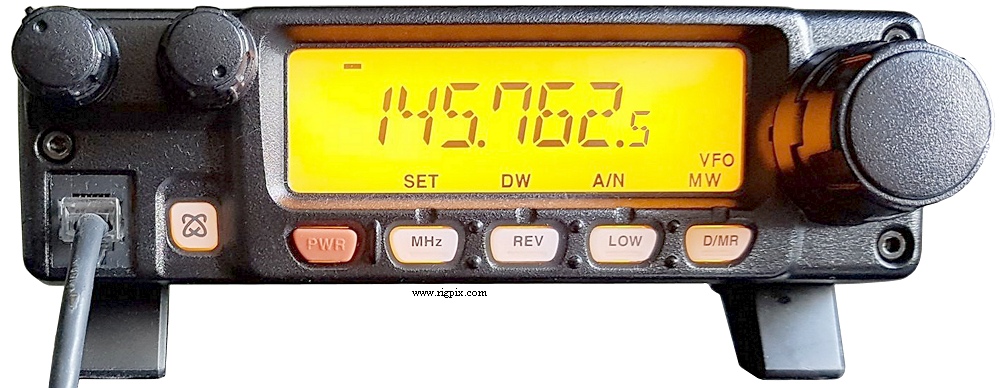
They all work great and never have I ever had a problem with them.
I really want to build myself a small hamshack and get a 100FT tower or something...

This hobby is sooooo expensive!
Senior Member
Joined: Aug 2005
Posts: 4,813
Likes: 0
From: Aurora Texas
Those are nice rigs....I do have an old Kenwood, 741A, 2m rig sitting in my office, dead as door nails. Going to take it to Ham Com in DFW and sell it for 10 bucks.

