


1715 troyer performance chips


Thread Starter
|
Member
Joined: Oct 2004
Posts: 23
Likes: 0
From: Wa
1715 troyer performance chips
I just installed my Troyer 1715 and love the difference it has made. My concern is the '' Tow-Pref" VRS "performance". I understand you can tow using the performance mode as long as you are under 4000lbs. Is that correct, if so what is the recomended tow weight for the "tow-pref". I tow a 2 sled trailer through Mt. Pass in Wa State, (sled weight for two = 1000lbs max) and occasional trash trailer to the dump with carpet and foreclosed home junk. (600 lbs top)
Any advise would be greatful
01 F150 Screw
3' lift
Afe Intake
Dual Cat back Exhaust
4:56 gears
315/75R16
Troyer 1715
A.R.E. canopy
Any advise would be greatful
01 F150 Screw
3' lift
Afe Intake
Dual Cat back Exhaust
4:56 gears
315/75R16
Troyer 1715
A.R.E. canopy

Former Sponsor
Joined: Mar 1998
Posts: 13,385
Likes: 4
From: Virginia
Hi zofro,
I'll get to your question in just a minute, but first I have to point something out, so please bear with me..........................
This has been covered here many, many times - which means you can easily use the SEARCH feature to look up such basic information. Most people who come here want to know the same things, so a lot of this falls into what we call "the basics" around here, and thus can easily be found using the SEARCH feature. The icon to access it is in the upper right portion of your screen here, & you'll want to get used to working with it's search filters so you can instantly access any info in any post ever made here. For example, just in the past few days alone there have been numerous posts here asking that exact same information. Virtually anything you can think to ask about any Superchips product (and most other topics related to Computer Chips) has already been asked & answered here hundreds, if not literally thousands of times before, and thus is available quickly & easily by using the SEARCH feature that is provided here for that purpose. Just FYI so you'll know for future reference.........
OK, now to get on to what you actually wanted to know...............
Towing means *towing*- not carrying weight in the vehicle or in the bed, etc. So for example, if you needed to put a 200 or 400 lb. freezer in the bed to take it to a friend's house, you don't need to change programs to do that. You can have passengers on board, luggage in the bed, etc. and still use the performance tuning in the 1715.
But any time you are towing up those kinds of grades, and considering the increased load on the motor from those tall tires, etc. (even with the gear change), I would NOT use the maximum performance tune in the 1715 Micro Tuner. Use the towing-capable tune any time you are towing, that's what it's made for - it has the richer A/F ratios & other aspects required for safe towing all the way right up to the factory's tow rating of the vehicle, up any grade, hill, mountain, etc.
If you like, you can install an EGT gauge so you can monitor the exhaust gas temperatures and *then* you can see whether you can safely get away with towing those lighter weights up that grade on the higher performance tune in the 1715 - but I would NOT try towing up any significant grade like that on the high performance tuning in the 1714 without an EGT gauge. (We carry those gauges of course, if at some point you want to do that.)
EGT gauges are something that are, unfortunately, far too many times overlooked - most people think EGT gauges (sometimes called "pyrometers") are only for turbo-diesel trucks, but the fact is EGT's are very important even on these normally aspirated gasoline engines. I run one in my truck - that way I *know* instantly whether the motor is operating safely or not, and what I can or cannot get away with on a certain type of tune, etc. This is just a tip in case you really want to be able to tell for certain if you can safely tow those lighter weights up that kind of grade on the higher performance tune in the 1715!
Good luck, & please feel free to give us a call to go over any of this in more detail, OK?
I'll get to your question in just a minute, but first I have to point something out, so please bear with me..........................
This has been covered here many, many times - which means you can easily use the SEARCH feature to look up such basic information. Most people who come here want to know the same things, so a lot of this falls into what we call "the basics" around here, and thus can easily be found using the SEARCH feature. The icon to access it is in the upper right portion of your screen here, & you'll want to get used to working with it's search filters so you can instantly access any info in any post ever made here. For example, just in the past few days alone there have been numerous posts here asking that exact same information. Virtually anything you can think to ask about any Superchips product (and most other topics related to Computer Chips) has already been asked & answered here hundreds, if not literally thousands of times before, and thus is available quickly & easily by using the SEARCH feature that is provided here for that purpose. Just FYI so you'll know for future reference.........
OK, now to get on to what you actually wanted to know...............
Towing means *towing*- not carrying weight in the vehicle or in the bed, etc. So for example, if you needed to put a 200 or 400 lb. freezer in the bed to take it to a friend's house, you don't need to change programs to do that. You can have passengers on board, luggage in the bed, etc. and still use the performance tuning in the 1715.
But any time you are towing up those kinds of grades, and considering the increased load on the motor from those tall tires, etc. (even with the gear change), I would NOT use the maximum performance tune in the 1715 Micro Tuner. Use the towing-capable tune any time you are towing, that's what it's made for - it has the richer A/F ratios & other aspects required for safe towing all the way right up to the factory's tow rating of the vehicle, up any grade, hill, mountain, etc.
If you like, you can install an EGT gauge so you can monitor the exhaust gas temperatures and *then* you can see whether you can safely get away with towing those lighter weights up that grade on the higher performance tune in the 1715 - but I would NOT try towing up any significant grade like that on the high performance tuning in the 1714 without an EGT gauge. (We carry those gauges of course, if at some point you want to do that.)
EGT gauges are something that are, unfortunately, far too many times overlooked - most people think EGT gauges (sometimes called "pyrometers") are only for turbo-diesel trucks, but the fact is EGT's are very important even on these normally aspirated gasoline engines. I run one in my truck - that way I *know* instantly whether the motor is operating safely or not, and what I can or cannot get away with on a certain type of tune, etc. This is just a tip in case you really want to be able to tell for certain if you can safely tow those lighter weights up that kind of grade on the higher performance tune in the 1715!
Good luck, & please feel free to give us a call to go over any of this in more detail, OK?
Thread Starter
|
Member
Joined: Oct 2004
Posts: 23
Likes: 0
From: Wa
Superchips Distributor
Thanks Mike,
I'm new here and was unawear of the search feature. I'll be sure to use it for future reference checks.
I Think I will not risk the risk and switch back t the Tow-Pref. I power level is not that degraded and I'm not racing anybody anyway!!
By the way I had many oportunities to pick up many diferent chip products, But after reading all the great reports on "Troyer Performance" you earned another loyal customer. Thanks loads.
I'm new here and was unawear of the search feature. I'll be sure to use it for future reference checks.
I Think I will not risk the risk and switch back t the Tow-Pref. I power level is not that degraded and I'm not racing anybody anyway!!
By the way I had many oportunities to pick up many diferent chip products, But after reading all the great reports on "Troyer Performance" you earned another loyal customer. Thanks loads.
Former Sponsor
Joined: Mar 1998
Posts: 13,385
Likes: 4
From: Virginia
Hi Zofro,
You're very welcome - and I hope you enjoy using the SEARCH feature, as once you use it's search filters a little bit you'll be able to access virtually anything you could want to know almost instantly, and that's very cool. I try to point out it's presence rather often, simply because it's icon is not really very noticeable, so many people don't even notice that it's here, even those that have been here awhile.
You're right, the difference in power level on a V8 between the tow-perf and the max perf tune in the 1715 Micro Tuner is about 6-8 HP at the rear wheels - so it's not like it's going to make a difference you will feel in the seat of the pants, especially with tall tires, etc.
In the 1715, the towing tune is set up for a 12.0:1 A/F in open loop, whereas the maximum performance tune will yield about a 12.4-12.6:1 A/F ratio - so there are some conditions when lighter weights can be towed when no grades are involved, etc - but I would never do that with the 1715 without an EGT gauge to monitor those temps so you know *for sure*.
The idea behind the maximum performance tune in the 1715 was to provide a program for use on good quality premium gas anywhere in the country (91-93 octane), but *without* the additional load of towing (weight) on the motor - without having to compensate the tuning for heavier loads from towing, that allows us to set the A/F's a bit leaner (12.6:1 for example), and that picks up another 6-8 HP at the rear wheels on average. Now absolute maximum power in a normally aspirated gasoline engine will occur somewhere about the 13.0:1 range, but in trucks & SUV's we run them a little bit richer to keep the EGT's (exhaust gas temperatures) in line - so as you can see, it all comes back to the EGT's, which tell us the conditions in the combustion chamber.
Have fun,
You're very welcome - and I hope you enjoy using the SEARCH feature, as once you use it's search filters a little bit you'll be able to access virtually anything you could want to know almost instantly, and that's very cool. I try to point out it's presence rather often, simply because it's icon is not really very noticeable, so many people don't even notice that it's here, even those that have been here awhile.
You're right, the difference in power level on a V8 between the tow-perf and the max perf tune in the 1715 Micro Tuner is about 6-8 HP at the rear wheels - so it's not like it's going to make a difference you will feel in the seat of the pants, especially with tall tires, etc.
In the 1715, the towing tune is set up for a 12.0:1 A/F in open loop, whereas the maximum performance tune will yield about a 12.4-12.6:1 A/F ratio - so there are some conditions when lighter weights can be towed when no grades are involved, etc - but I would never do that with the 1715 without an EGT gauge to monitor those temps so you know *for sure*.
The idea behind the maximum performance tune in the 1715 was to provide a program for use on good quality premium gas anywhere in the country (91-93 octane), but *without* the additional load of towing (weight) on the motor - without having to compensate the tuning for heavier loads from towing, that allows us to set the A/F's a bit leaner (12.6:1 for example), and that picks up another 6-8 HP at the rear wheels on average. Now absolute maximum power in a normally aspirated gasoline engine will occur somewhere about the 13.0:1 range, but in trucks & SUV's we run them a little bit richer to keep the EGT's (exhaust gas temperatures) in line - so as you can see, it all comes back to the EGT's, which tell us the conditions in the combustion chamber.
Have fun,

Member
Joined: Oct 2002
Posts: 33
Likes: 0
My problem is that I run the performance program on the tuner and no matter what gas I buy the truck always seams to ping. I have found Citgo gas to be the best but even it pings some under normal driving conditions. So people would say run it on the tow-perf tune but why whould I want to do that-I dont tow anything and that programs yields less HP. To me the problem seems like the motor just is not getting enough fuel under full throttle. I want to have a custom tuner to fix the solution but it is hard to find a respectable person to trust to do the tune. Anyone have any suggestions.


Former Sponsor
Joined: Mar 1998
Posts: 13,385
Likes: 4
From: Virginia
Hello ncracing6x,
Assuming that there aren't any mechanical problems like old O2's, DPFE sensor, EGR problems, etc., the solution is very simple - use better quality gas, or you'll have to drop back to a less aggressive tune in the 1715.
It doesn't matter that you don't *want* to drop back to a less aggressive tune - what matters is what your local fuel quality can actually *support*. That is what determines how aggressive the tuning can be without the motor detonating, is the fuel it's run on. In a situation like this, that's the first thing to learn about "tuning," is that you have to do whatever it takes to STOP any detonation that is either consistent, heavy, or prolonged - or at least operate it in a manner that does not cause detonation.
When it's detonating, that means the PCM has already done all it can do based on the knock sensor's output voltage & how the knock sensor system is calibrated in the PCM's programming - well, apparently it has already done all it can do, and it STILL cannot quell the detonation - that's a sign of poor fuel quality (or a mechanical problem with the vehicle, like EGR, etc.), not that it's running too lean due to the 1715 - the 1715 will NOT cause any engine to run inappropriately lean. All ego aside, we are America's premier F-150 performance tuning specialist, having done this longer than anyone else - and I can tell you that adding more fuel is most likely NOT going to fix your problem. By the way, speaking of adding fuel - because there is no data in your post, I'm guessing that you haven't ever had the A/F's tested, or done any other datalogging, either - that being the case, you really can't know what conditions the motor is operating under or what it's A/F ratios really are, or any number of other things. At this point, you know that it's pinging and that this needs to stop. Without solid data, you can't say that more fuel would do anything to help your detonation - and it won't, all that will do is reduce power. I can tell you that the A/F ratios are fine in the tunes in that 1715 - the 1715 does not cause any vehicle to run inappropriately lean.
By the way - it's very easy to find a "respectable person to do the tune" - in case you don't know it, you just found them - us. Nobody has more experience performance tuning F-150's, and you can find hundreds of posts here from many of our customers. We've specialized in performance tuning the F-150 platform for 12 years.
If your truck is a 4.6, and especially if it's a pre-2001 model, then most likely you simply have a factory code that is too aggressive to begin with, and one that may even show a tendency to detonate on the stock tune on 87 octane fuel - Ford did that for a few years on these 4.6 F-150's before getting that fixed in later years, and some of those vehicles really need a proper custom tune done to deliver an appropriate spark curve. Heck, some of the 1997-1999 4.6 models need less spark in some areas than what's in the stock factory tuning, even in a premium gas tune!
We can handle this for you if you like, and we can get even *more* performance out of that truck at the same time, so that you can stop the detonation *and* have more performance, too. You might want to give us a call at our number listed below and talk with us about just what we can do for your truck.
In the meantime, don't let that detonation continue - drop back to the 87 octane tune and continue to use premium gas, or just go back to the stock factory tune and use whatever level of octane is required to stop the detonation, or stay out of the throttle, etc., etc. Whatever you do, just please do not let consistent, or heavy, or prolonged detonation continue unchecked - if its only happening at full-throttle, then you can just stay out of the throttle until you get this taken care of, for example. You probably know all of that already, I'm only mentioning this just in case.
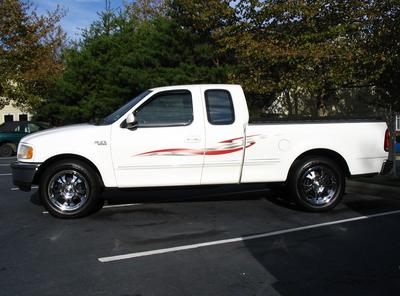
Best of luck with your truck whatever you decide to do, you've got a nice looking vehicle there!
We hope to hear from you,
Assuming that there aren't any mechanical problems like old O2's, DPFE sensor, EGR problems, etc., the solution is very simple - use better quality gas, or you'll have to drop back to a less aggressive tune in the 1715.
It doesn't matter that you don't *want* to drop back to a less aggressive tune - what matters is what your local fuel quality can actually *support*. That is what determines how aggressive the tuning can be without the motor detonating, is the fuel it's run on. In a situation like this, that's the first thing to learn about "tuning," is that you have to do whatever it takes to STOP any detonation that is either consistent, heavy, or prolonged - or at least operate it in a manner that does not cause detonation.
When it's detonating, that means the PCM has already done all it can do based on the knock sensor's output voltage & how the knock sensor system is calibrated in the PCM's programming - well, apparently it has already done all it can do, and it STILL cannot quell the detonation - that's a sign of poor fuel quality (or a mechanical problem with the vehicle, like EGR, etc.), not that it's running too lean due to the 1715 - the 1715 will NOT cause any engine to run inappropriately lean. All ego aside, we are America's premier F-150 performance tuning specialist, having done this longer than anyone else - and I can tell you that adding more fuel is most likely NOT going to fix your problem. By the way, speaking of adding fuel - because there is no data in your post, I'm guessing that you haven't ever had the A/F's tested, or done any other datalogging, either - that being the case, you really can't know what conditions the motor is operating under or what it's A/F ratios really are, or any number of other things. At this point, you know that it's pinging and that this needs to stop. Without solid data, you can't say that more fuel would do anything to help your detonation - and it won't, all that will do is reduce power. I can tell you that the A/F ratios are fine in the tunes in that 1715 - the 1715 does not cause any vehicle to run inappropriately lean.
By the way - it's very easy to find a "respectable person to do the tune" - in case you don't know it, you just found them - us. Nobody has more experience performance tuning F-150's, and you can find hundreds of posts here from many of our customers. We've specialized in performance tuning the F-150 platform for 12 years.
If your truck is a 4.6, and especially if it's a pre-2001 model, then most likely you simply have a factory code that is too aggressive to begin with, and one that may even show a tendency to detonate on the stock tune on 87 octane fuel - Ford did that for a few years on these 4.6 F-150's before getting that fixed in later years, and some of those vehicles really need a proper custom tune done to deliver an appropriate spark curve. Heck, some of the 1997-1999 4.6 models need less spark in some areas than what's in the stock factory tuning, even in a premium gas tune!
We can handle this for you if you like, and we can get even *more* performance out of that truck at the same time, so that you can stop the detonation *and* have more performance, too. You might want to give us a call at our number listed below and talk with us about just what we can do for your truck.
In the meantime, don't let that detonation continue - drop back to the 87 octane tune and continue to use premium gas, or just go back to the stock factory tune and use whatever level of octane is required to stop the detonation, or stay out of the throttle, etc., etc. Whatever you do, just please do not let consistent, or heavy, or prolonged detonation continue unchecked - if its only happening at full-throttle, then you can just stay out of the throttle until you get this taken care of, for example. You probably know all of that already, I'm only mentioning this just in case.
Best of luck with your truck whatever you decide to do, you've got a nice looking vehicle there!
We hope to hear from you,
Trending Topics
Member
Joined: Oct 2002
Posts: 33
Likes: 0
Sounds good Mike. I want you to do a custom tune for it but the problem is I have been trying to get in touch with you for the past 3 months and you never return my phone call. So my trust level has fell extremely low. If you want to do the tune then you call me. I called your shop this morning and left a message with my #. Also I am looking at putting some underdrive pulleys on but I was wondering if that affects the tuning any. Lastly, is it true that the custom tune will add in general another 10 rear wheel HP? Hope to hear from you soon.
Member
Joined: Oct 2002
Posts: 33
Likes: 0
Mike-my computer code is IMP4. What kind of gains can I see in custom tuning vs the 1715 tuner? Also the truck is mechanically sound b/c it reads no codes on diagnostic readouts. Lastly, is a DFPE sensor the same as a detonation sensor?Thanks
Former Sponsor
Joined: Mar 1998
Posts: 13,385
Likes: 4
From: Virginia
You'll see about 50% larger power & performance gains with our custom tuning versus what you get in the 1715.
No, the DPFE has nothing whatsoever to do with the knock sensor -
By the way - just FYI - the fact that you aren't reading any codes does *not* mean the truck is "mechanically sound" - not by a long shot. All that means is that the PCM is not currently reporting any *hard* codes - it doesn't mean everything is ok, or that the DPFE sensor is ok, or that the PCM shouldn't be reporting codes, etc.
Never think the OBD-II system is always going to throw a code when something is wrong, as it may or it may not. We've seen A/F's as lean as 19:1 still not cause a code, and hundreds of other examples of the OBD-II system not reporting problems when it should, etc. Never think of OBD-II as some sort of foolproof or absolute reporting system, it's not even close.
No, the DPFE has nothing whatsoever to do with the knock sensor -
By the way - just FYI - the fact that you aren't reading any codes does *not* mean the truck is "mechanically sound" - not by a long shot. All that means is that the PCM is not currently reporting any *hard* codes - it doesn't mean everything is ok, or that the DPFE sensor is ok, or that the PCM shouldn't be reporting codes, etc.
Never think the OBD-II system is always going to throw a code when something is wrong, as it may or it may not. We've seen A/F's as lean as 19:1 still not cause a code, and hundreds of other examples of the OBD-II system not reporting problems when it should, etc. Never think of OBD-II as some sort of foolproof or absolute reporting system, it's not even close.