



CB antenna mounting? Bed mount


Thread Starter
|
Member
Joined: Apr 2013
Posts: 12
Likes: 0
From: Fargo, North Dakota
 CB antenna mounting? Bed mount
I'm majorly having an issue with how I'm going to be able to mount my CB antennas. I'm planning on mounting them in the front of the bed, but how do I go about trying to install them? Not sure how I'm going to even install them when the gap between the cab and the bed is so small on the 06 F150s... And as far as I see, there's absolutely no videos anywhere on how to mount them on the bed. I've seen plenty of the same generation F150 with the same mount I'm trying to accomplish here. But I just don't see how I'm going to be able to tighten the bolts down once the holes have been drilled. The gap is too small to fit anything and accurately install the back plate of the mount there.
Any suggestions?
Any suggestions?

Senior Member

Joined: Mar 2013
Posts: 6,677
Likes: 0
From: Houston and College Station, TX
This may not help much, but a toolbox makes it a lot easier. Mine are mounted right on the side. I have a few buddies with theirs mounted right to the bed of their 04-08 F150s, so I'll try to get a look at theirs. I don't know how I don't know how they're attached . . . I usually look at stuff like that.

Senior Member
Joined: Sep 2009
Posts: 3,031
Likes: 45
From: The Shenandoah Valley

In this day where no one drills a hole, I don't know where you'ld mount a CB antenna on a PU unless magnetic or to a tool box. Back in the day, we thought nothing of drilling a hole if needed to mount an antenna we were going to use the whole time we had the vehicle.
A CB/8Track combo? Should have kept it .... it'ld be a museum piece now .... 

Senior Member
Joined: Nov 2011
Posts: 165
Likes: 4
From: Florida
In this day where no one drills a hole, I don't know where you'ld mount a CB antenna on a PU unless magnetic or to a tool box. Back in the day, we thought nothing of drilling a hole if needed to mount an antenna we were going to use the whole time we had the vehicle.
A CB/8Track combo? Should have kept it .... it'ld be a museum piece now ....
A CB/8Track combo? Should have kept it .... it'ld be a museum piece now ....


Senior Member
Joined: Mar 2007
Posts: 2,275
Likes: 2
From: League City, Texas
IF you have a toolbox, mount it there, BUT... Make sure you have a sizeable backing plate to avoid distorting your toolbox. I had to go back in and reinforce mine. (In the process of...).
Put the mount as close to the center line of the vehicle as possible, and as high as possible for best SWR (Standing Wave Ratio).
You mentioned antenna(S) as in plural. If you are running a co phased rig (twin atnennas) to get them to work right you need 108" (1/4 wave) separation between the radiating elements (Antennas). I highly doubt you really want to do that... You are far better off with a single 102" stainless steel whip antenna, or a corkscrew type antenna like a Predator 10K if you don't want a tall radiating element...
Put the mount as close to the center line of the vehicle as possible, and as high as possible for best SWR (Standing Wave Ratio).
You mentioned antenna(S) as in plural. If you are running a co phased rig (twin atnennas) to get them to work right you need 108" (1/4 wave) separation between the radiating elements (Antennas). I highly doubt you really want to do that... You are far better off with a single 102" stainless steel whip antenna, or a corkscrew type antenna like a Predator 10K if you don't want a tall radiating element...
Senior Member
Joined: Mar 2013
Posts: 6,677
Likes: 0
From: Houston and College Station, TX
I guess vehicles were a little more disposable back in the day. There ain't a chance in hell I'd ever drill a hole in my bed  I wanted a flag mount for my bed, and spent $70 in supplies making a massive support deal for it, while others drilled some holes and stuck some C clamps (is that what they're called? Same ones you use to run conduit, whatever those suckers are called) in the corner of the bed . . .
I wanted a flag mount for my bed, and spent $70 in supplies making a massive support deal for it, while others drilled some holes and stuck some C clamps (is that what they're called? Same ones you use to run conduit, whatever those suckers are called) in the corner of the bed . . .
Trending Topics

Senior Member
Joined: Dec 2012
Posts: 472
Likes: 0
From: Wisconsin
[QUOTE=KMAC0694;5044401]I guess vehicles were a little more disposable back in the day. [QUOTE]
I think they are more disposable today. Back in the day everything wasn't built out of ABS plastic, they used heavier gauge sheet metal, heavier gauge wire was used, etc. I could go on and on, but trucks were built to last . . . at least they had good intentions when they built them. Today everything is about the bottom line. When they set out to design a truck today, the first thing upper management asks the engineers is, "whats the cheapest way to get the job done?" They will jeopardies a part's integrity over a few cents because those few cents will net millions of dollars in profit. On the other hand though, trucks do ride better today, they are more comfortable, and they are more efficient. However, they are not as durable because of this. I really like my truck, but it will never take a beating like a 79' would. Just taking it out mudding in a field would probably damage some sensor or a CV boot. Because soccer moms want a nice ride to the mall I can't have a solid front axle in a half-ton. I think the frames are a lot tougher on the modern trucks, but that is about it.
I think they are more disposable today. Back in the day everything wasn't built out of ABS plastic, they used heavier gauge sheet metal, heavier gauge wire was used, etc. I could go on and on, but trucks were built to last . . . at least they had good intentions when they built them. Today everything is about the bottom line. When they set out to design a truck today, the first thing upper management asks the engineers is, "whats the cheapest way to get the job done?" They will jeopardies a part's integrity over a few cents because those few cents will net millions of dollars in profit. On the other hand though, trucks do ride better today, they are more comfortable, and they are more efficient. However, they are not as durable because of this. I really like my truck, but it will never take a beating like a 79' would. Just taking it out mudding in a field would probably damage some sensor or a CV boot. Because soccer moms want a nice ride to the mall I can't have a solid front axle in a half-ton. I think the frames are a lot tougher on the modern trucks, but that is about it.
Senior Member
Joined: Sep 2009
Posts: 3,031
Likes: 45
From: The Shenandoah Valley
As I grew up middle class most all the families in our neighborhood owned two vehicles max, one usually newer than the other, the older being used more for work commuting. Station wagons were popular because they could serve as a family sedan while also doing many things a 1/2 ton PU would be asked to do.
Senior Member
Joined: Mar 2013
Posts: 6,677
Likes: 0
From: Houston and College Station, TX
A lot of people got a new car every 3 years and they were wore the hell out at 100k miles from everything I've ever been told. Both parents grew up in regular, middle class, blue collar families and my mom's father was the head mechanic at his own shop. And used ones weren't worth anywhere near as much as they are now. I hate the plastic too, and I love older vehicles, and use the same "don't make em like they used to" phrase but they were honestly crap compared to new ones in a lot of ways IMO. And I'm not talking about "creature comforts" and a comfy ride. I glorify the older ones, but they were still very finicky and unreliable in their own ways. I absolutely hate how everything is indeed about the bottom line, and that goes for everything. Things are made to be thrown away now, and are purposefully not built to last as long as possible because of "planned obsolescence." And I think it's disgusting. I want to fix it, not replace it.
I've been defending the EB, V6 motors, and now I'm defending the new vehicles I despise while doing the opposite for the old ones I love! Don't know what I'm doing. Biggest difference IMO is that an older vehicle you could fix yourself without worrying about stupid electronics and computers not liking what you're doing, but you can't now. I think the older ones broke more, but were easy to fix, whereas these don't break as often, but are an absolute b*tch when they do. I'll always prefer the former. I don't think it will ultimately be affordable to keep current vehicles for 15+ years like it may have been before when all the electronics start failing.
I don't think gas equalled anywhere near $3 until now. Maybe during all the OPEC stuff, but even then . . . Inflation from then to now is x8-10, not 30
http://inflationdata.com/Inflation/I...ices_Table.asp
Can you recall filling up then and thinking "damn, I just spent the entire week's groceries on gas?" One gallon cost the equivalent of $.080 in today's money in 1955 based on that link, and 70 cents for 1965. $3.36 for 1980 (1979), but that's the all-time high and only one year, much less for all others. (31.5 gallons per barrel)
I've been defending the EB, V6 motors, and now I'm defending the new vehicles I despise while doing the opposite for the old ones I love! Don't know what I'm doing. Biggest difference IMO is that an older vehicle you could fix yourself without worrying about stupid electronics and computers not liking what you're doing, but you can't now. I think the older ones broke more, but were easy to fix, whereas these don't break as often, but are an absolute b*tch when they do. I'll always prefer the former. I don't think it will ultimately be affordable to keep current vehicles for 15+ years like it may have been before when all the electronics start failing.
I don't think gas equalled anywhere near $3 until now. Maybe during all the OPEC stuff, but even then . . . Inflation from then to now is x8-10, not 30
http://inflationdata.com/Inflation/I...ices_Table.asp
Can you recall filling up then and thinking "damn, I just spent the entire week's groceries on gas?" One gallon cost the equivalent of $.080 in today's money in 1955 based on that link, and 70 cents for 1965. $3.36 for 1980 (1979), but that's the all-time high and only one year, much less for all others. (31.5 gallons per barrel)
Last edited by KMAC0694; Dec 15, 2013 at 03:28 AM.
Senior Member
Joined: Sep 2009
Posts: 3,031
Likes: 45
From: The Shenandoah Valley
I haven't drilled a hole in my '07 FX4's bed yet, but then I don't have a CB. If I did want one on it, likely I'ld come up with a bracket at the front of the bed behind the cab that would clear my Undercover, where if I drilled any holes it would be 2 in the bed front wall.
Cars did wear faster back then, but it wasn't because people considered them more disposable as you said earlier. It was poorer roads (more dirt roads then too, and often those had "fords" instead of bridges, that also sometimes served as the local car wash), materials, lubricants, dirtier gas, points, plugs, carbs, road draft tubes, cotton corded, later nylon & rayon tires with narrow treads, .... cars weren't necessarily worn out at 100K and 3 years either, not on average .... but many suffered in wrecks on the many more two lane roadways that were rougher, styles changed every year or two, people easily tired of the old '57 when they saw the newest '59 or '60 model, but someone was always there to buy the old '57. Yeah, the style changes had a lot to do with how a 49 Plymouth "go to work car" looked so old in a driveway behind the family's 68 Plymouth Sta Wagon .... but that old '49 still got the job done.
I currently have a '77 F-150 4x4, a '92 Thunderbird Sport, a '95 Thunderbird LX, a '01 Merc Grand Marquis, a '03 Forester, a '07 FX4 scab flareside, and a '08 Mustang .... the '01 Merc will soon be the magic "13" you mention .... and it's taking us to Georgia for Christmas .... and I've no plans top sell it. Man, if it was points and condenser, plugs every 10K and carbs to adjust, chokes to adjust, no way I could keep all these vehicles up.
You talk about "worth of used cars then versus now .... market determines that .... and while dad maybe sold a good running 54 Chevy Bel Air in 1963 for $300, likely my Dad was making maybe $8-10,000 a year then as an engineer in mobile radio section at GE with good benefits so we did OK. I retired from LE in 2010, my average final compensation was $70K. I did sell a buddy a '84 Subaru GL hatch back (4x4 with Hi & Lo)with only 187K miles for $100 in 2009, but I was selling him the new tires, gave him the car as rust was advancing .... he used it another couple years before the pass floor fell out in the field one day while he was going in to hunt. I suggested home made sub frame connectors and some steel plate .... I think he still uses it on a farm.
You might look at the right page first .... Gasoline Prices- Inflation Adjusted http://inflationdata.com/Inflation/I..._Inflation.asp
It doesn't mean a lot to say gas was $0.25 a gallon way back when until you realize how long a person worked to earn that $0.25. You'll see the cheap year ranges were late-mid 80s up into maybe 2002. If that's when you grew up and got used to paying for gas, then you may well have a distorted view of history.
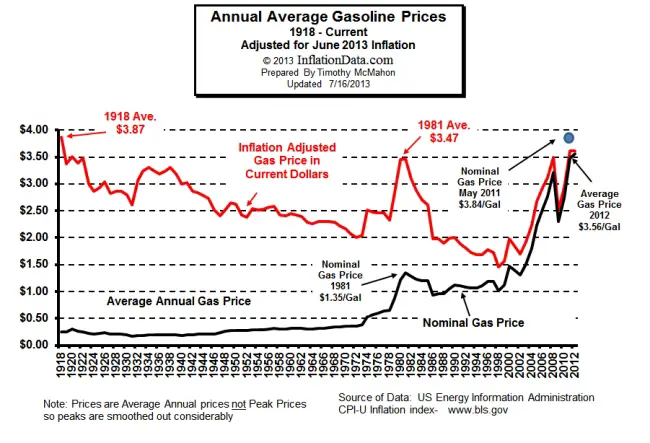
And all through the earlier years up into '70s, etc .... 15-16 mpg was GOOD on the highway, 14 wasn't bad. Partly because of carbs and inprecise mixtures and simple timing based on vacuum vs engine speed vs initial ... and the roads I spoke of had more hills to coast and then climb. Our '68 Plymouth Satelite SW averaged 8 mpg in town. Read the old magazines printed back in the '50s and '60s and even '70s, road test , Popular Mechanics, Cars, Road & Track, Motor Trend, Car Life, Car & Driver .... people most certainly desired good gas mileage cause gas wasn't cheap in their eyes. In the '50s when we lived in West Texas, Dad always bought 6 cylinder Chevies, even in the '56 wagon and '57 shop "sedan delivery", as he wanted good mileage. Our '59 big Bel Air Sta Wagon with bat wings, 283 2bbl with PG for mileage.
Merry Christmas to you all ....
A lot of people got a new car every 3 years and they were wore the hell out at 100k miles from everything I've ever been told. Both parents grew up in regular, middle class, blue collar families and my mom's father was the head mechanic at his own shop. And used ones weren't worth anywhere near as much as they are now. I hate the plastic too, and I love older vehicles, and use the same "don't make em like they used to" phrase but they were honestly crap compared to new ones in a lot of ways IMO. And I'm not talking about "creature comforts" and a comfy ride. I glorify the older ones, but they were still very finicky and unreliable in their own ways. I absolutely hate how everything is indeed about the bottom line, and that goes for everything. Things are made to be thrown away now, and are purposefully not built to last as long as possible because of "planned obsolescence." And I think it's disgusting. I want to fix it, not replace it.
I've been defending the EB, V6 motors, and now I'm defending the new vehicles I despise while doing the opposite for the old ones I love! Don't know what I'm doing. Biggest difference IMO is that an older vehicle you could fix yourself without worrying about stupid electronics and computers not liking what you're doing, but you can't now. I think the older ones broke more, but were easy to fix, whereas these don't break as often, but are an absolute b*tch when they do. I'll always prefer the former. I don't think it will ultimately be affordable to keep current vehicles for 15+ years like it may have been before when all the electronics start failing.
I've been defending the EB, V6 motors, and now I'm defending the new vehicles I despise while doing the opposite for the old ones I love! Don't know what I'm doing. Biggest difference IMO is that an older vehicle you could fix yourself without worrying about stupid electronics and computers not liking what you're doing, but you can't now. I think the older ones broke more, but were easy to fix, whereas these don't break as often, but are an absolute b*tch when they do. I'll always prefer the former. I don't think it will ultimately be affordable to keep current vehicles for 15+ years like it may have been before when all the electronics start failing.
I currently have a '77 F-150 4x4, a '92 Thunderbird Sport, a '95 Thunderbird LX, a '01 Merc Grand Marquis, a '03 Forester, a '07 FX4 scab flareside, and a '08 Mustang .... the '01 Merc will soon be the magic "13" you mention .... and it's taking us to Georgia for Christmas .... and I've no plans top sell it. Man, if it was points and condenser, plugs every 10K and carbs to adjust, chokes to adjust, no way I could keep all these vehicles up.
You talk about "worth of used cars then versus now .... market determines that .... and while dad maybe sold a good running 54 Chevy Bel Air in 1963 for $300, likely my Dad was making maybe $8-10,000 a year then as an engineer in mobile radio section at GE with good benefits so we did OK. I retired from LE in 2010, my average final compensation was $70K. I did sell a buddy a '84 Subaru GL hatch back (4x4 with Hi & Lo)with only 187K miles for $100 in 2009, but I was selling him the new tires, gave him the car as rust was advancing .... he used it another couple years before the pass floor fell out in the field one day while he was going in to hunt. I suggested home made sub frame connectors and some steel plate .... I think he still uses it on a farm.
I don't think gas equalled anywhere near $3 until now. Maybe during all the OPEC stuff, but even then . . . Inflation from then to now is x8-10, not 30
http://inflationdata.com/Inflation/I...ices_Table.asp
Can you recall filling up then and thinking "damn, I just spent the entire week's groceries on gas?" One gallon cost the equivalent of $.080 in today's money in 1955 based on that link, and 70 cents for 1965. $3.36 for 1980 (1979), but that's the all-time high and only one year, much less for all others. (31.5 gallons per barrel)
http://inflationdata.com/Inflation/I...ices_Table.asp
Can you recall filling up then and thinking "damn, I just spent the entire week's groceries on gas?" One gallon cost the equivalent of $.080 in today's money in 1955 based on that link, and 70 cents for 1965. $3.36 for 1980 (1979), but that's the all-time high and only one year, much less for all others. (31.5 gallons per barrel)
It doesn't mean a lot to say gas was $0.25 a gallon way back when until you realize how long a person worked to earn that $0.25. You'll see the cheap year ranges were late-mid 80s up into maybe 2002. If that's when you grew up and got used to paying for gas, then you may well have a distorted view of history.
And all through the earlier years up into '70s, etc .... 15-16 mpg was GOOD on the highway, 14 wasn't bad. Partly because of carbs and inprecise mixtures and simple timing based on vacuum vs engine speed vs initial ... and the roads I spoke of had more hills to coast and then climb. Our '68 Plymouth Satelite SW averaged 8 mpg in town. Read the old magazines printed back in the '50s and '60s and even '70s, road test , Popular Mechanics, Cars, Road & Track, Motor Trend, Car Life, Car & Driver .... people most certainly desired good gas mileage cause gas wasn't cheap in their eyes. In the '50s when we lived in West Texas, Dad always bought 6 cylinder Chevies, even in the '56 wagon and '57 shop "sedan delivery", as he wanted good mileage. Our '59 big Bel Air Sta Wagon with bat wings, 283 2bbl with PG for mileage.
Merry Christmas to you all ....
Last edited by tbear853; Dec 15, 2013 at 03:50 PM.
Senior Member
Joined: Dec 2012
Posts: 472
Likes: 0
From: Wisconsin
KMAC0694 & tbear853. You guys both make great points, and one has to consider all of the factors we face today.
My great grandfather owned one of the largest salvage yards in my state. When my Dad worked there he scraped a lot of perfectly good cars. If he would have been able to save just a few of the 57' Chevys, Mustangs, Corvettes, etc he would be a multimillionaire many times over. If you had a good job in a factory back then it was nothing to buy a new car every 1-2 years. People would just park their cars by the gate at night and leave them. If they left the car running, my Dad knew only the starter was bad. Automakers changed the cars almost every year and nobody wanted to drive last year's model if they didn't have to. Back then only one spouse needed to work and middle class families could easily afford a house, a car or two, and a bunch of kids. My Mom's father always bought a new car almost every year.
Today inflation has ruined everything, and wages have not increased with it; instead they have remained relatively flat. Minimum wage back in the 60's was about $17/hr today. Minimum wage should be about $22.00/hr today if it kept pace with increases in worker productivity. These days, 1 out of 4 Americans make less than $10.00/hr. Today it would take a lot of folks 3 years before taxes to buy a nicely equipped XLT. That doesn't include the taxes, registration, insurance, and gas to drive it.
I think a lot more people would trade their cars in more regularly if they could, but on the other hand, if the vehicle is just used on the road it will last a lot longer than a typical car years ago. Take it off road, and that is another story. I just pulled a car out of the ditch today; its plastic bumper was all cracked to s#%* from hitting a snow drift. Look at Toyota FJ Cruisers; they are complete garbage and will not go through half the stuff that a good Bronco or Jeep from they 1970s would.
My great grandfather owned one of the largest salvage yards in my state. When my Dad worked there he scraped a lot of perfectly good cars. If he would have been able to save just a few of the 57' Chevys, Mustangs, Corvettes, etc he would be a multimillionaire many times over. If you had a good job in a factory back then it was nothing to buy a new car every 1-2 years. People would just park their cars by the gate at night and leave them. If they left the car running, my Dad knew only the starter was bad. Automakers changed the cars almost every year and nobody wanted to drive last year's model if they didn't have to. Back then only one spouse needed to work and middle class families could easily afford a house, a car or two, and a bunch of kids. My Mom's father always bought a new car almost every year.
Today inflation has ruined everything, and wages have not increased with it; instead they have remained relatively flat. Minimum wage back in the 60's was about $17/hr today. Minimum wage should be about $22.00/hr today if it kept pace with increases in worker productivity. These days, 1 out of 4 Americans make less than $10.00/hr. Today it would take a lot of folks 3 years before taxes to buy a nicely equipped XLT. That doesn't include the taxes, registration, insurance, and gas to drive it.
I think a lot more people would trade their cars in more regularly if they could, but on the other hand, if the vehicle is just used on the road it will last a lot longer than a typical car years ago. Take it off road, and that is another story. I just pulled a car out of the ditch today; its plastic bumper was all cracked to s#%* from hitting a snow drift. Look at Toyota FJ Cruisers; they are complete garbage and will not go through half the stuff that a good Bronco or Jeep from they 1970s would.
Senior Member
Joined: Mar 2013
Posts: 6,677
Likes: 0
From: Houston and College Station, TX
Everything you said makes sense, tbear. Thank you for sharing with me! Did you and others worry about gas being expensive when growing up and through the years? That was the main thing I'd heard is that folks weren't taken to the shed every time they filled up and they weren't constantly concerned with it. But hell, people now can't complain if gas cost that much over time and their little Prius is getting 50 mpg! I don't even think gas is that expensive and never really have, because I've always compared it to Europe. But they can largely blame taxes and over-sensistivity to "destroying the earth" for that.
Merry Christmas, buddy!
Thank you too, FX4SC. I had this window open for a long time before submitting my post. That's very true that vehicles cost a lot more nowadays. It's insane how much a little ole modest XLT like the one I've got with basic options costs new when compared to what most folks make. I think of FJs like cushier jeeps, and WAY too many of them are 2wd, which says a lot. They're also very expensive.
Merry Christmas, buddy!
Thank you too, FX4SC. I had this window open for a long time before submitting my post. That's very true that vehicles cost a lot more nowadays. It's insane how much a little ole modest XLT like the one I've got with basic options costs new when compared to what most folks make. I think of FJs like cushier jeeps, and WAY too many of them are 2wd, which says a lot. They're also very expensive.
Last edited by KMAC0694; Dec 15, 2013 at 05:36 PM.