



Troyer Efan trouble


Thread Starter
|
Member
Joined: Sep 2012
Posts: 11
Likes: 0
Troyer Efan trouble
Hello, found your site while searching the internet about my fan problems. I bought the dual fan kit from Troyer recently and after driving the truck only a few times the low-temp fan will not turn off. I had to pull the fuse to get it to go off. I called Troyer and told them what it was doing and the guy told me to go to my local parts store and buy a new controller.. WHAT??? This kit is brand new and he wants me to go buy a controller. I told him he should send me a controller for it if that's the problem and he said he doesn't have any. After a good bit of discussion I told him I would just send the kit back to him for a refund. He then transferred me to another guy who miraculously found that they had 2 controllers in stock and said he would send me one. I asked him if the one he is sending is any better than the first one. He said it was the same and that I am the first one to call with a problem with it. I know that's a lie. I asked him if I could just return the kit and he told me to hold on and he would get Mike Troyer to talk to me. After holding a little while he came back on the phone and said Mr Troyer was "On the Dyno" and would call me back in a few minutes. I waited several hours with no call and finally called back. The guy that answered knew who I was and I told him that Mike Troyer never called me back. He said "He's still on the Dyno and will call you before the day it out". I never got a call back at all. Is this normal for Troyer to have no customer service? I just spent $500 on this kit and can't even get the guy to call me back. If anyone has any suggestions I would be glad to hear them. I have a 1500 mile road trip coming up in 3 weeks and I sure would like to have working fans by then.
Thread Starter
|
Member
Joined: Sep 2012
Posts: 11
Likes: 0
Well, I waited until about noon today and still no call back so I called them again. A lady answered the phone and apologized that nobody called me back. She told me someone would be contacting me soon. About an hour later Mrs Troyer called me. She said that they would not take the kit back since I had installed it. I didn't really think they would. She said for me to go to the auto parts store and buy 2 new 30 amp relays and replace the relays on the controllers and that should take care of it. She said to fax her the receipt and she would pay for the relays and $10 for my trouble. So, I guess I'll buy some relays and hope that takes care of the problem. I have a 1500 mile road-trip coming up at the end of October and this whole deal makes me nervous. I should have kept my old mechanical fan I guess.

Senior Member
Joined: Sep 2009
Posts: 3,031
Likes: 45
From: The Shenandoah Valley

I like the idea of electric fans, I've considered them several times as I expect they'ld save some on gas ....
... but then I like reliability too and I know the factory fan setup is reliable whether belt or electric drive.
I read these posts and I wonder about aftermarket setups? Seems it's often the controlers that go on the fritz.
I expect truth be known most aftermarket setups are reliable too, you just hear about the defects?
... but then I like reliability too and I know the factory fan setup is reliable whether belt or electric drive.
I read these posts and I wonder about aftermarket setups? Seems it's often the controlers that go on the fritz.
I expect truth be known most aftermarket setups are reliable too, you just hear about the defects?
Last edited by tbear853; Feb 10, 2013 at 04:06 PM.

Senior Member
Joined: Jul 2007
Posts: 2,036
Likes: 2
From: Maine
Troyers controllers are a KNOWN trouble area. The fans are superior though. I have had the Troyer fans in the past, but used them with a DC Controller without any problems (Delta Current Control).


Technical Article Contributor
Joined: Aug 2006
Posts: 7,862
Likes: 0
From: Northern California
This is how I would do it, and plan to eventually.
http://www.f150forum.com/f4/motorcra...cs-vid-114646/
http://www.f150forum.com/f4/motorcra...cs-vid-114646/
Senior Member
Joined: Jul 2007
Posts: 2,036
Likes: 2
From: Maine
This is how I would do it, and plan to eventually.
http://www.f150forum.com/f4/motorcra...cs-vid-114646/
http://www.f150forum.com/f4/motorcra...cs-vid-114646/
Trending Topics
Thread Starter
|
Member
Joined: Sep 2012
Posts: 11
Likes: 0
I just wanted to update this thread for anyone that may be considering Troyer EFans. I bought HD relays like they told me to do and replaced the stock ones. Since I started this thread back in September I have been through 3 sets of relays and I only drive my truck on the weekends. I can't believe I paid that much money for this garbage. Anybody that runs across this thread while looking for E Fans do yourself a huge favor and STAY AWAY FROM TROYER! Wife drove the truck to work today and when I got home it was sitting in the garage with the fan running. This is ridiculous! TROYER efan CONTROLLERS ARE JUNK.... run away, far far away!

Senior Member
Joined: Nov 2006
Posts: 2,068
Likes: 2
From: So. Cal.
I just wanted to update this thread for anyone that may be considering Troyer EFans. I bought HD relays like they told me to do and replaced the stock ones. Since I started this thread back in September I have been through 3 sets of relays and I only drive my truck on the weekends. I can't believe I paid that much money for this garbage. Anybody that runs across this thread while looking for E Fans do yourself a huge favor and STAY AWAY FROM TROYER! Wife drove the truck to work today and when I got home it was sitting in the garage with the fan running. This is ridiculous! TROYER efan CONTROLLERS ARE JUNK.... run away, far far away!


Thread Starter
|
Member
Joined: Sep 2012
Posts: 11
Likes: 0
Yes, I'm positive. They work fine until one day you turn the key off and the fan keeps running. The relay contacts keep welding together on them.
Senior Member
Joined: Sep 2009
Posts: 3,031
Likes: 45
From: The Shenandoah Valley
I'ld make sure to add a quenching diode circuit on the switching terminals if not so equipped.
http://www.bcae1.com/relays.htm
http://www.wiringproducts.com/conten...ive-relay.html
Thread Starter
|
Member
Joined: Sep 2012
Posts: 11
Likes: 0
The relay that's welded shut on it right now is a 60 amp relay but I don't really know what you mean by "quenching diode circuit". You would think I would be able to use what was sent in the kit without having to add anything for what this stuff costs.
Senior Member
Joined: Sep 2009
Posts: 3,031
Likes: 45
From: The Shenandoah Valley
Well, I was sent a link to a simple explanation, I replied to the author, then deleted the message and forgot to save that link .... so maybe the author resends it? If so, I'll post it as well.
Anyway .... read the page displayed in that first link I provided.... http://www.bcae1.com/relays.htm. It won't take long and it is a good explanation of relays and how they work. Then about half way down, it goes into quenching diodes and their use.
It does not hurt to have more than one so redundancy does not hurt.
Just make sure the diode is wired correctly. Pay attention to the schematic and symbols.
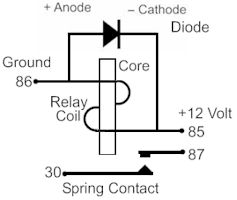
A clearer picture is here:
85 is likely from the controller
86 is the ground side (or 85 could be power and 86 a switched ground, either way works to operate a relay coil)
87 and 30 are the two terminals that actually switch the power to the fans, etc. Likely 87 is hot and 30 goes to the fan but it'll work either way.
Diodes are very cheap.
Anyway .... read the page displayed in that first link I provided.... http://www.bcae1.com/relays.htm. It won't take long and it is a good explanation of relays and how they work. Then about half way down, it goes into quenching diodes and their use.
It does not hurt to have more than one so redundancy does not hurt.
Just make sure the diode is wired correctly. Pay attention to the schematic and symbols.
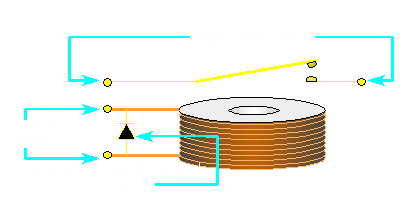
Quenching Diodes:
Anytime that a relay coil is driven by a circuit that is not specifically designed to drive a relay, you should use a quenching/suppression diode connected in parallel with the relay coil. The diagram below will show the connection of the diode. Initially, you may think the diode serves no purpose because the voltage applied to the relay cannot pass through the diode. This is true when the relay is energized. The diode comes into play when the power source is removed from the relay coil. When power is applied to the relay coil, a magnetic field is created and energy is stored in the coil. When power is removed, the magnetic field collapses causing a reverse voltage to be generated (it's called inductive kickback or back EMF). The back EMF can easily reach 200 volts. The diode will absorb the reverse voltage spike. This voltage, if not absorbed by the diode, will cause premature failure of switch contacts and may cause the failure of power switching transistors. You can use virtually any type of rectifier or switching diode (i.e. 1N4001, 1N4002, 1N400x... or Radio Shack part #s 276-1101, 276-1102, 276-1103, 276-1104).
Anytime that a relay coil is driven by a circuit that is not specifically designed to drive a relay, you should use a quenching/suppression diode connected in parallel with the relay coil. The diagram below will show the connection of the diode. Initially, you may think the diode serves no purpose because the voltage applied to the relay cannot pass through the diode. This is true when the relay is energized. The diode comes into play when the power source is removed from the relay coil. When power is applied to the relay coil, a magnetic field is created and energy is stored in the coil. When power is removed, the magnetic field collapses causing a reverse voltage to be generated (it's called inductive kickback or back EMF). The back EMF can easily reach 200 volts. The diode will absorb the reverse voltage spike. This voltage, if not absorbed by the diode, will cause premature failure of switch contacts and may cause the failure of power switching transistors. You can use virtually any type of rectifier or switching diode (i.e. 1N4001, 1N4002, 1N400x... or Radio Shack part #s 276-1101, 276-1102, 276-1103, 276-1104).
A clearer picture is here:
85 is likely from the controller
86 is the ground side (or 85 could be power and 86 a switched ground, either way works to operate a relay coil)
87 and 30 are the two terminals that actually switch the power to the fans, etc. Likely 87 is hot and 30 goes to the fan but it'll work either way.
Diodes are very cheap.
Last edited by tbear853; Feb 11, 2013 at 12:45 PM.

