


Where to wire gauges?


Suspended
Joined: Nov 2004
Posts: 1,941
Likes: 2
From: NW Indiana
Water temp from the block???? Good way of getting the coldest reading in your whole entire cooling system. 
Water temp should be taken from the intake manifold(if your aluminum) before the t-stat, thats going to be your hottest spot right???
Trans temp should never be taken from your pan, that about 15* cooler than the actual temp. You want a t-fitting going to your TOP trans line feeding into the radiator, thats where your hottest fluid is, right?
Oil psi, they got it on the head. . .
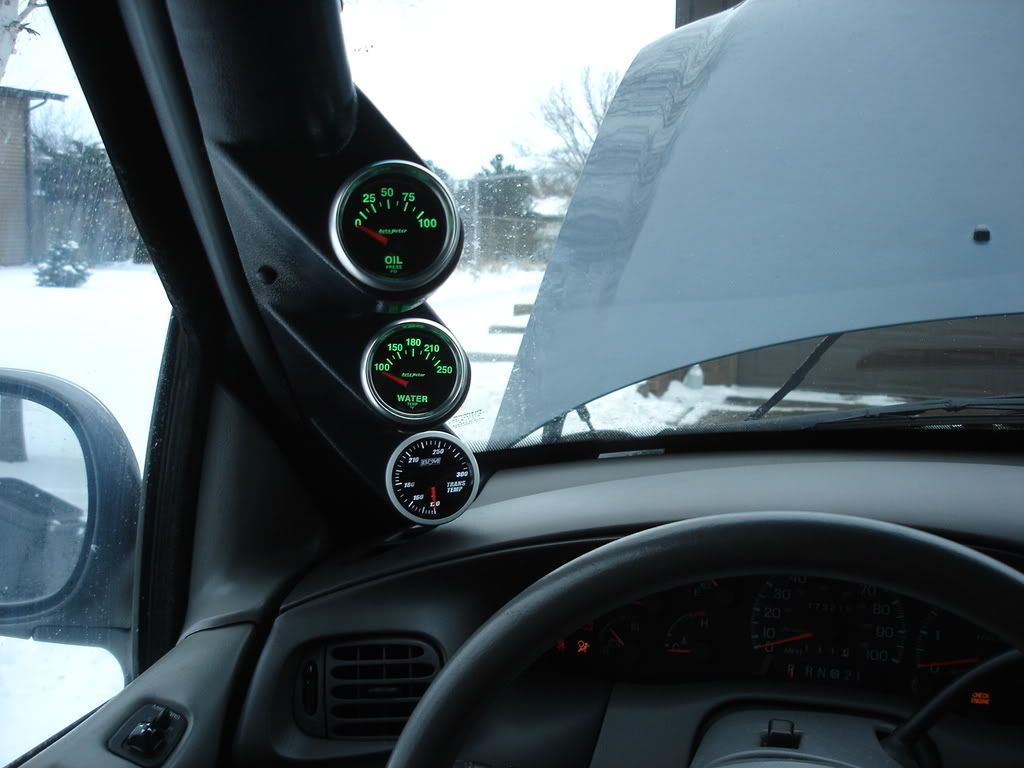


Water temp should be taken from the intake manifold(if your aluminum) before the t-stat, thats going to be your hottest spot right???
Trans temp should never be taken from your pan, that about 15* cooler than the actual temp. You want a t-fitting going to your TOP trans line feeding into the radiator, thats where your hottest fluid is, right?
Oil psi, they got it on the head. . .

Senior Member
Joined: Jul 2004
Posts: 6,200
Likes: 39
From: Easton, Pa.
Actually the hottest trans temp is right out of the converter at the transmission before it has a chance to cool at all going to the radiator cooler.
At this point you see in real time what happens as the transmission spends time in it's locked and unlocked conditions as you drive.
Temp rise is caused by the fluid shear in the converter when unlocked.
Also be prepared to see temps well over what you would see with a sensor in the pan as well as fast response time to changing conditions and fast cool down once the truck is stopped and turned off.
The operating temp range is quite wide during operation depending on load, driving habit, outside temp and what extra cooling there may be.
Average pan temp is of little value and too late to detect an overheating problem before to much damage 'might' have been done while working the truck hard at load hauling or towing.
Very heavy towing can drive temp into the 250 range on hills and is normal unless it stays there full time while driving then you don't have enough cooling or there is an issue developing.
It's all in your perspective and knowing what is normal and what is not.
At this point you see in real time what happens as the transmission spends time in it's locked and unlocked conditions as you drive.
Temp rise is caused by the fluid shear in the converter when unlocked.
Also be prepared to see temps well over what you would see with a sensor in the pan as well as fast response time to changing conditions and fast cool down once the truck is stopped and turned off.
The operating temp range is quite wide during operation depending on load, driving habit, outside temp and what extra cooling there may be.
Average pan temp is of little value and too late to detect an overheating problem before to much damage 'might' have been done while working the truck hard at load hauling or towing.
Very heavy towing can drive temp into the 250 range on hills and is normal unless it stays there full time while driving then you don't have enough cooling or there is an issue developing.
It's all in your perspective and knowing what is normal and what is not.
Suspended
Joined: Nov 2004
Posts: 1,941
Likes: 2
From: NW Indiana
Only place to grab that hottest temp from converter(top line) is at the line. If any, it will lose maybe 1 degree if tapping the t up by the radiator. I see my trans to 180 when beating on the truck or wheelin, and go down below 120 while highway driving.


Thread Starter
|
Senior Member
Joined: Oct 2007
Posts: 3,439
Likes: 0
From: farmington hills, MI
wow talk about revivin a thread from the dead
mine in the pan works just fine yeah i know its 20* cooler or w/e than on the outgoing port but i rarely see it leave 100* unless i leave it idle after the trucks warm for abour 15 mins then it will go to 140* i also have amsoil tranny fluid i figured id spend 115 bucks on trans fluid after my rebuilt.
As for the engine temp i would think that would be the hottest place for the temp. its the farthus away from the radator and the coolant going by that senor has just ran threw a hot engine were 1400* explostions are taking place.
The oil press yeah it kidna sucks havin a dead gauge on the dash but we didnt have a T-fitting oh well id rather see numbers than a normal thingy on the dash.
Did you know from my aftermarket temp gauge vs my dash temp gauge i only see the dash one move from the bottom line to the normal area from 0-140 on my after market ive ran my truck till it got to 220-240* and the dash gauge never moved at all!!!! why is this?
BTW camarothatcould pretty good looking gauges what brand are they?
mine in the pan works just fine yeah i know its 20* cooler or w/e than on the outgoing port but i rarely see it leave 100* unless i leave it idle after the trucks warm for abour 15 mins then it will go to 140* i also have amsoil tranny fluid i figured id spend 115 bucks on trans fluid after my rebuilt.
As for the engine temp i would think that would be the hottest place for the temp. its the farthus away from the radator and the coolant going by that senor has just ran threw a hot engine were 1400* explostions are taking place.
The oil press yeah it kidna sucks havin a dead gauge on the dash but we didnt have a T-fitting oh well id rather see numbers than a normal thingy on the dash.
Did you know from my aftermarket temp gauge vs my dash temp gauge i only see the dash one move from the bottom line to the normal area from 0-140 on my after market ive ran my truck till it got to 220-240* and the dash gauge never moved at all!!!! why is this?
BTW camarothatcould pretty good looking gauges what brand are they?

Senior Member
Joined: Dec 2002
Posts: 1,558
Likes: 3
From: Eastern TN
All of my Fords have had the oil pressure sending unit down on the side of the block, FWIW.
Suspended
Joined: Nov 2004
Posts: 1,941
Likes: 2
From: NW Indiana
I meant they 'got it right on the head'. . . meaning right.
I thought the point of gauges was to prevent failure, wheter it be heat related or lubrication lacking. I dont think we can prevent damage if our reading is below what it actually is. I'd like to know immediately if my temp is spiking instead of being 10-15 degrees too late
I thought the point of gauges was to prevent failure, wheter it be heat related or lubrication lacking. I dont think we can prevent damage if our reading is below what it actually is. I'd like to know immediately if my temp is spiking instead of being 10-15 degrees too late
Senior Member
Joined: Dec 2002
Posts: 1,558
Likes: 3
From: Eastern TN
I've had the water temp sensor where you see it for 5 years now. The temperature on my gauge has always followed the thermostat, within a few degrees or so.
The same thing goes with the tranny - the peak temps coming out of the torque converter mean nothing with respect to how the overall transmission temps are doing. If you are cruising on the interstate and the temp is 150* and you stomp it for a mile and the temp spikes to 180* in the line, do you really think the other 20+ quarts of fluid and all the metal parts in the tranny have magically gotten 30* hotter in that short period of time ?
In your world, you are monitoring the temp of tranny fluid that is superheated as it exits the torque converter and goes by the sending unit in a COOLING line. I am monitoring the other 20+ quarts in the system to see what the real overall operating temperature of the system is.
Again, it is personal preference and a difference of opinion.
