


Noise after truck turns off


Thread Starter
|
Senior Member
Joined: Jul 2006
Posts: 174
Likes: 0
Noise after truck turns off
I've ran across a thread before that was about this same problem but i had no luck searching. not sure what this part is call but it's located on the driver side of the throttle body cover. looks like it has 2 vacuum lines going into it. after the truck runs if i turn it off there is a somewhat hissing noise coming from that part? is this a problem? if so what is the solution.thanks


Technical Article Contributor
Joined: Oct 2005
Posts: 25,641
Likes: 19
From: MI
No problems - It's working as it should. Some just get noisy after awhile.
The "noise" proves it's working. You can clean the filter under the solenoid cap if you like , but don't expect the noise to stop.
It's alright
The "noise" proves it's working. You can clean the filter under the solenoid cap if you like , but don't expect the noise to stop.
It's alright
Thread Starter
|
Senior Member
Joined: Jul 2006
Posts: 174
Likes: 0
Originally Posted by jbrew
No problems - It's working as it should. Some just get noisy after awhile.
The "noise" proves it's working. You can clean the filter under the solenoid cap if you like , but don't expect the noise to stop.
It's alright
The "noise" proves it's working. You can clean the filter under the solenoid cap if you like , but don't expect the noise to stop.
It's alright

Technical Article Contributor
Joined: Oct 2005
Posts: 25,641
Likes: 19
From: MI
Originally Posted by iziris
could you tell me the name of the part just for my own knowledge?
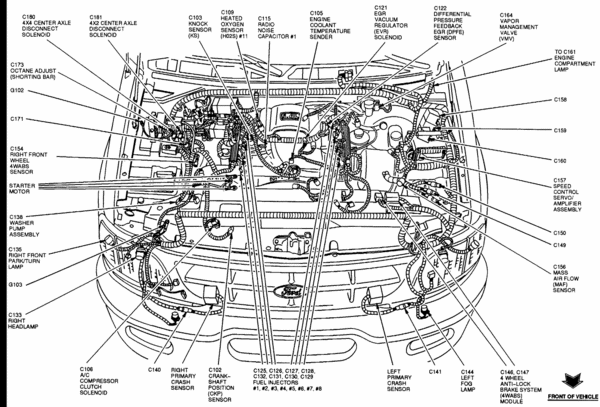
However, Ford calls it - EGR Vacuum Regulator

Thread Starter
|
Senior Member
Joined: Jul 2006
Posts: 174
Likes: 0
Trending Topics
Technical Article Contributor
Joined: Oct 2005
Posts: 25,641
Likes: 19
From: MI
No Problem -
The EVR regulates the vacuum to the EGR valve and is controlled by a pulse-width signal to open and close the EGR valve. As the duty cycle pulse width signal increases, the EVR increases the vacuum to the EGR which opens further and admits more gas into the inlet system.
{{{Vacuum not directed to the EGR valve is vented to atmosphere}}}. Even at zero duty cycle (no voltage) some vacuum will still pass the EVR, but this is not enough to overcome the spring pressure. It is not until the EVR is at 40% duty cycle that the vacuum is enough to overcome the EGR spring pressure.
That's what your hearing - ie, in bold
The EVR regulates the vacuum to the EGR valve and is controlled by a pulse-width signal to open and close the EGR valve. As the duty cycle pulse width signal increases, the EVR increases the vacuum to the EGR which opens further and admits more gas into the inlet system.
{{{Vacuum not directed to the EGR valve is vented to atmosphere}}}. Even at zero duty cycle (no voltage) some vacuum will still pass the EVR, but this is not enough to overcome the spring pressure. It is not until the EVR is at 40% duty cycle that the vacuum is enough to overcome the EGR spring pressure.
That's what your hearing - ie, in bold

