


Need help ( Bucking , Chugging )


Technical Article Contributor
Joined: Oct 2005
Posts: 25,641
Likes: 19
From: MI
Originally Posted by Pinhead-227
It seems that if the COP's were getting weak than the misfire would be more noticable either at idle or under heavy load, which isn't the case.
NOPE - Wrong! I suggest following the tech's recommendations.
Last edited by jbrew; Feb 1, 2008 at 11:28 PM.

Senior Member
Joined: Jul 2004
Posts: 6,200
Likes: 39
From: Easton, Pa.
Diagnostics over the internet is difficult to do based on info given that may or may not be totally accurate so the diagnostic direction may not be quite correct, at times.
What is not being realized about certain stumble and missing problems is the most difficult ignition times for these motors are at low load, light throttle condition and road speeds.
The reasons are as follows:
1. The fuel is cut back to a lean condition by design and intent.*
2. The EGR is opened to allow exhaust gas to flow back into the intake and mixes with the incoming air to further leans the mixture that is injested. Exhaust gas does not burn the second time.*
3. Being the mixture is so lean, it calls for the ignition timing to be advanced due to the the mixtures slower flame speeds under these lean conditions.*
4. The lean air/fuel ratios can go up to at least 20 to1.
These lean ratios are very hard to ignite compaired to acceleration runs or WOT conditions that are not nearly as hard to ignite.*
5. Add to this the possible erroded/fouled spark plugs and you have all conditions for missing and stumble.
6. Further add to these conditons any coil than has shorted turns that reduce it's high voltage output and you have stumble that shows intermittantly because a coil has run out of reserve voltage.*
Because of the intermittant actions the condition presents, the PCM can't pin the fault on any given cylinder so cannot set code of CEL lamp.*
It seems to handy to blame transmission shudder on this the but not very likely if one observes closely how the condition shows it'self and when, and not is a lack of fuel 'delivery' by filter or fuel pump.
A low output coil usually cannot be tested for by the average owner without doing a dynamic on motor test using the factory stress testing methods for absolute output comparing results to all other coils and to test limits.
Owners often replace all coils and do solve the stumble problem but the rule of the unknown it still present (which coil was it?). Do I have 7 good ones and which one is bad? So what do you do....throw them all out!
If one new coil is also faulty and it happens, you still have the problem and conclude incorrectly it's not the coils and continue on with the hassle until you go the second round and go back to coils again months or years later.
Admittedly there can always be more than one fault present at the same time and skews the attempts to diagnos the drivability by the non experieced.
Most owners are at a disadvantage with only 'surface' logic to use in trying to service a fault with a motor.
These motors are being controlled by a computer running on a program the same as what your using here to view this reply and it's so in depth that you have little working knowledge of what goes on with motor control and is why it becomes difficult to do service work based on surface logic and codes alone without and a deeper working system knowledge.
Some will become insulted by this reply, some will disagree, some will use it to see where they stand and some will learn by it.
The parts of the failure mechanics can be further explained but isn't of benifit for the present time, unless one wants to get deeper in to the reasons that all add up to the drivability issue.
* = indepth discriptions can be applied.
What is not being realized about certain stumble and missing problems is the most difficult ignition times for these motors are at low load, light throttle condition and road speeds.
The reasons are as follows:
1. The fuel is cut back to a lean condition by design and intent.*
2. The EGR is opened to allow exhaust gas to flow back into the intake and mixes with the incoming air to further leans the mixture that is injested. Exhaust gas does not burn the second time.*
3. Being the mixture is so lean, it calls for the ignition timing to be advanced due to the the mixtures slower flame speeds under these lean conditions.*
4. The lean air/fuel ratios can go up to at least 20 to1.
These lean ratios are very hard to ignite compaired to acceleration runs or WOT conditions that are not nearly as hard to ignite.*
5. Add to this the possible erroded/fouled spark plugs and you have all conditions for missing and stumble.
6. Further add to these conditons any coil than has shorted turns that reduce it's high voltage output and you have stumble that shows intermittantly because a coil has run out of reserve voltage.*
Because of the intermittant actions the condition presents, the PCM can't pin the fault on any given cylinder so cannot set code of CEL lamp.*
It seems to handy to blame transmission shudder on this the but not very likely if one observes closely how the condition shows it'self and when, and not is a lack of fuel 'delivery' by filter or fuel pump.
A low output coil usually cannot be tested for by the average owner without doing a dynamic on motor test using the factory stress testing methods for absolute output comparing results to all other coils and to test limits.
Owners often replace all coils and do solve the stumble problem but the rule of the unknown it still present (which coil was it?). Do I have 7 good ones and which one is bad? So what do you do....throw them all out!
If one new coil is also faulty and it happens, you still have the problem and conclude incorrectly it's not the coils and continue on with the hassle until you go the second round and go back to coils again months or years later.
Admittedly there can always be more than one fault present at the same time and skews the attempts to diagnos the drivability by the non experieced.
Most owners are at a disadvantage with only 'surface' logic to use in trying to service a fault with a motor.
These motors are being controlled by a computer running on a program the same as what your using here to view this reply and it's so in depth that you have little working knowledge of what goes on with motor control and is why it becomes difficult to do service work based on surface logic and codes alone without and a deeper working system knowledge.
Some will become insulted by this reply, some will disagree, some will use it to see where they stand and some will learn by it.
The parts of the failure mechanics can be further explained but isn't of benifit for the present time, unless one wants to get deeper in to the reasons that all add up to the drivability issue.
* = indepth discriptions can be applied.
Last edited by Bluegrass; Feb 1, 2008 at 04:25 PM.

Senior Member
Joined: Jan 2008
Posts: 134
Likes: 0
Originally Posted by Bluegrass
3. Being the mixture is so lean, it calls for the ignition timing to be advanced due to the the mixtures greater flame speeds under these lean conditions.*

Junior Member
Joined: Jan 2008
Posts: 16
Likes: 0
I have same problem
Big Lou,
I'm Very interested in this post as i have the same problem and exact symtoms
my post is here :
https://www.f150online.com/forums/sh...d.php?t=319222
Good luck
I'm Very interested in this post as i have the same problem and exact symtoms
my post is here :
https://www.f150online.com/forums/sh...d.php?t=319222
Good luck

Thread Starter
|
Junior Member
Joined: Jan 2008
Posts: 14
Likes: 0
From: Arkansas
Originally Posted by 1stfordowned
Big Lou,
I'm Very interested in this post as i have the same problem and exact symtoms
my post is here :
https://www.f150online.com/forums/sh...d.php?t=319222
Good luck
I'm Very interested in this post as i have the same problem and exact symtoms
my post is here :
https://www.f150online.com/forums/sh...d.php?t=319222
Good luck
 . This weekend I will try to find the vacuum hose on the plenuum going to the EGR vacuum system. If anyone has a pic and can give me a good description of how to locate this thing that would be awesome. If that don't do it Its off to the mechanic come Monday to change the COP's and plugs.
Technical Article Contributor
Joined: Oct 2005
Posts: 25,641
Likes: 19
From: MI
Originally Posted by Big Lou
Read your post and it seems exactly the same. I think I am more confused than when I first asked . This weekend I will try to find the vacuum hose on the plenuum going to the EGR vacuum system. If anyone has a pic and can give me a good description of how to locate this thing that would be awesome. If that don't do it Its off to the mechanic come Monday to change the COP's and plugs.
. This weekend I will try to find the vacuum hose on the plenuum going to the EGR vacuum system. If anyone has a pic and can give me a good description of how to locate this thing that would be awesome. If that don't do it Its off to the mechanic come Monday to change the COP's and plugs.http://cgi.ebay.com/ebaymotors/NEW-I...mZ150210793215
If you really want to check the EGR , Check the valve operation first. Here I'll post you a few pics first so that you can locate easier -
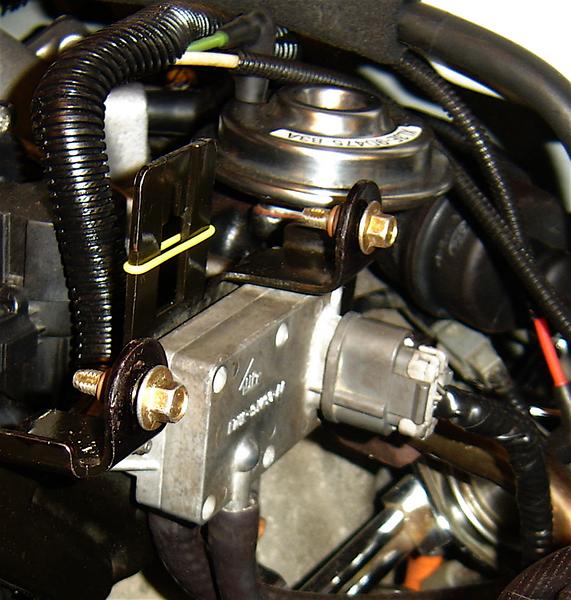

You need to suck test the EGR valve to test. If you don't have a vac tester you can test the this way.
Start your vehicle, while @ idle disconnect the green vac line from the EGR valve. Find a piece of hose about 3' long that you can plug into the EGR valve in place of the green line. While your Vehicle is still at idle , suck on the hose like you were drinking a milkshake. Does your idle change? does it want to stall? If so , then the EGR valve is good . If there is no deflection or change in idle speed your EGR valve needs to be replaced..
Here's what the valve looks like inside -
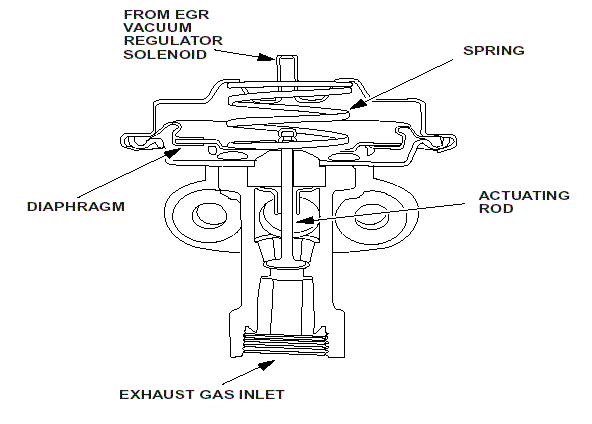

Thread Starter
|
Junior Member
Joined: Jan 2008
Posts: 14
Likes: 0
From: Arkansas
Ok , I took off the 90 degree boot that has the green tube to it and hooked up another hose. I started the truck and with it in park I sucked on the hose and the engine almost stalled so I am guessing the valve is good right ? Must be the COP's and or plugs ? The green hose looks good with no visible holes or dry rot.
Guy's I really appreciate all the help.
Thanks,
Lou
Guy's I really appreciate all the help.
Thanks,
Lou
Technical Article Contributor
Joined: Oct 2005
Posts: 25,641
Likes: 19
From: MI
You have a low grade misfire - How many miles Lou? When is the last time the plugs were changed ?
Yea , right , as said before , before this thread became infected - The quickest way is a stress test at the dealership.
There's a cheaper way - only if your comfortable with changing the plugs yourself . We can direct you through this if applicable.
Yea , right , as said before , before this thread became infected
- The quickest way is a stress test at the dealership.There's a cheaper way - only if your comfortable with changing the plugs yourself . We can direct you through this if applicable.
Thread Starter
|
Junior Member
Joined: Jan 2008
Posts: 14
Likes: 0
From: Arkansas
55,000 give or take a few hundred miles. Plugs are original. I have changed plugs before in my old doge and my old buick but they seems harder to get to in this truck. If it is not something you would think to hard for someone with limited knowledge I might take it to a mechanic. Does his have to be done by a dealer or can I go to a local mechanic ?
Technical Article Contributor
Joined: Oct 2005
Posts: 25,641
Likes: 19
From: MI
Originally Posted by Big Lou
55,000 give or take a few hundred miles. Plugs are original. I have changed plugs before in my old doge and my old buick but they seems harder to get to in this truck. If it is not something you would think to hard for someone with limited knowledge I might take it to a mechanic. Does his have to be done by a dealer or can I go to a local mechanic ?
Yea , your do for a change - close enough.
The price for a plug at the dealerships vary. A Simple quote from the ones in your area would be wise - call at-least 3 . I would definitely go thru the dealership for this one. - If your not comfortable with it yourself. After receiving your quote, ask what the price is for a new coil. Chances are you'll need one or two. Add this to the quote
We can help you thru it with illustrations pictures and "how to's" . You'll also do a better job yourself this way. It takes about 2 hours to do - The average dealership charges 2.9 hours on your model.
It may take you half a day to do thoroughly. Check out this "how to" to help with your decision. -
https://www.f150online.com/forums/li...parkplugs.html
Last edited by jbrew; Feb 3, 2008 at 01:48 PM.