


Cooling lines in throttle body


Thread Starter
|
Member
Joined: Sep 2006
Posts: 60
Likes: 0
From: Land O Lakes,FL
Cooling lines in throttle body
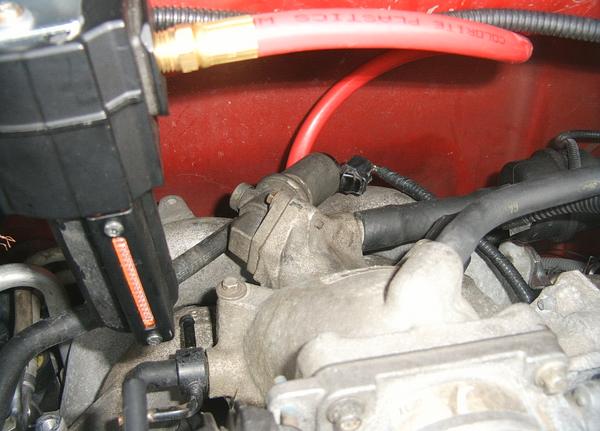
I tried to search for this but no luck. I am pulling my engine for a rebuild and while taking the upper coolant hose off the throttle body the nipple broke. A freind of mine told me most of the mustang guys just plug that off anyway as it does nothing. Is this true? The truck is a '94 F350 4X4 351.

Senior Member
Joined: Jul 2006
Posts: 6,282
Likes: 1
From: Farmington, MO
i dont really see the NEED for it, so you should be ok to plug it. Heck, When my truck was up to full temperature, I pulled it off thinking it was a vacuum line once... after burning my hand severely, i realized its a coolant line!



Senior Member
Joined: Jul 2007
Posts: 415
Likes: 0
From: Columbia, MO
It is not critical, but I am sure they put in on there for a reason. It would be much cheaper to cast the TB without cooling jackets. It could be used for warming up air while cold would be my guess. Or even just warming up the TB period on cold days. Can't see it really cooling anything (air) so that is the only reason I could see.

Technical Article Contributor

Joined: Dec 1997
Posts: 9,417
Likes: 11
From: Windsor,Ontario,Canada
It is there to keep the incoming PVC air warm. This has a warming effect on the air in the throttle body and helps prevent icing. I had a carb ice up on me once. Simple solution was to clutch in turn off engine and coast to the side of the road and fix it. With todays revlimited engines you need only to shift into neutral and coast to the side of the road. Regardless of my ramblings I have driven the truck this was for quite a while now and I suffered no ill effects. If anything in the summer it keeps the incoming air form warming up. 
JMC
JMC
Trending Topics


Technical Article Contributor
Joined: Oct 2005
Posts: 25,641
Likes: 19
From: MI
WOW! I have that as well . I have wanted to eliminate that for along time , it's a PITA to deal with. I really haven't figured out how to go about it yet. I always thought about doing that in away it would benefit if possible.
Ok , I'm gonna ramble a bit JMC . At times I've heard coolant flowing threw the heater core after shut down. Sounds like air pockets within the system. It's done this for years without a problem - I just hear it allot in the summer. I point the finger @ those coolant lines as it's harder to bleed the air out the system because there up so high.
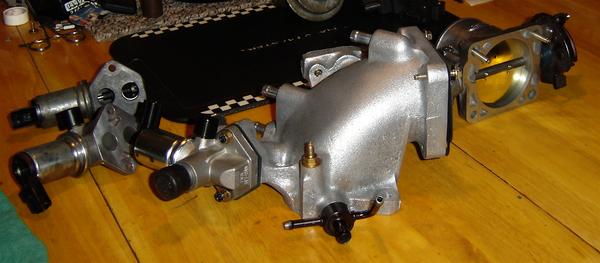
I have the 98 model, so I have the Coolant Temp Sensor on the Drivers side of the manifold. The 5/8 coolant line runs from the back of that to the tree on the Plenum. Other side of the tree theres another line running to the metal water pump to heater core inlet tube (the tube that's on top of the block and comes up behind the head).
Right now my main Vacuum line is connected in the middle of the Plenum between the EVAP (top) and Brake Booster (bottom) inlets.
Is there a way to Improve this? Like possibly plugging the tree coolant lines , moving the main vac supply to the tree side of the Plenum. Then using the previous Main Vac supply for more booster power. I've been curious if doing this would provide better braking with less air pockets within the coolant system - you know what I mean?
I don't like those lines up top - If you don't plug them right away when disconnecting , they p^ss all over the COP's if your not careful or get burnt like built did..
Mannn, now this is rambling
Ok , I'm gonna ramble a bit JMC
. At times I've heard coolant flowing threw the heater core after shut down. Sounds like air pockets within the system. It's done this for years without a problem - I just hear it allot in the summer. I point the finger @ those coolant lines as it's harder to bleed the air out the system because there up so high. I have the 98 model, so I have the Coolant Temp Sensor on the Drivers side of the manifold. The 5/8 coolant line runs from the back of that to the tree on the Plenum. Other side of the tree theres another line running to the metal water pump to heater core inlet tube (the tube that's on top of the block and comes up behind the head).
Right now my main Vacuum line is connected in the middle of the Plenum between the EVAP (top) and Brake Booster (bottom) inlets.
Is there a way to Improve this? Like possibly plugging the tree coolant lines , moving the main vac supply to the tree side of the Plenum. Then using the previous Main Vac supply for more booster power. I've been curious if doing this would provide better braking with less air pockets within the coolant system - you know what I mean?
I don't like those lines up top - If you don't plug them right away when disconnecting , they p^ss all over the COP's if your not careful or get burnt like built did..
Mannn, now this is rambling
Last edited by jbrew; Jan 24, 2008 at 12:04 PM.

Senior Member
Joined: Jan 2000
Posts: 3,205
Likes: 3
From: Along Lake Erie
My understanding is that it's there to provide warmth to the surface of the TB and prevent icing. I've seen carbs and throttle bodies ice-up in 95 degree temps due to the pressure drop through the throttle body (picture the condensation vortices that form behind a plane's wing when it's flared for landing). True in warm weather it's probably less of an issue than up here in the ice belt, but I'd leave it plugged in. It means admitting you have a little bit of faith in the engineers that designed the engine that they saw a need for it in some specific operating conditions that I may one day encounter.
[quote=Jbrew]Ok , I'm gonna ramble a bit JMC . At times I've heard coolant flowing threw the heater core after shut down. Sounds like air pockets within the system. It's done this for years without a problem - I just hear it allot in the summer. I point the finger @ those coolant lines as it's harder to bleed the air out the system because there up so high.
Are you sure it's not the AC? The refrigerant in the evaporator will continue to hiss, gurgle, and rumble after the motor is turned off until the pressure equalizes between the high and low sides. Air bubbles aren't going to form in the heater core (the coolest part of the system), especially after the engine is turned off. Keep in mind the system is running at 10-12 psi under normal operating conditions just to prevent the bubbles from forming. When you shut it down, the coolant in the block stops moving, and it *might* be possible for bubbles to form there if it manages to heat the coolant to its boiling point in the block, but the only way it can boil at that point (i.e. bubbles form) is if the system expands, and the only way the system (already under pressure) can expand is if you remove the radiator cap, and that is why it's not safe to remove the radiator cap on a hot motor.
{Holy run-on sentences, Batman!! What a ramble!!}
[quote=Jbrew]Ok , I'm gonna ramble a bit JMC . At times I've heard coolant flowing threw the heater core after shut down. Sounds like air pockets within the system. It's done this for years without a problem - I just hear it allot in the summer. I point the finger @ those coolant lines as it's harder to bleed the air out the system because there up so high.
Are you sure it's not the AC? The refrigerant in the evaporator will continue to hiss, gurgle, and rumble after the motor is turned off until the pressure equalizes between the high and low sides. Air bubbles aren't going to form in the heater core (the coolest part of the system), especially after the engine is turned off. Keep in mind the system is running at 10-12 psi under normal operating conditions just to prevent the bubbles from forming. When you shut it down, the coolant in the block stops moving, and it *might* be possible for bubbles to form there if it manages to heat the coolant to its boiling point in the block, but the only way it can boil at that point (i.e. bubbles form) is if the system expands, and the only way the system (already under pressure) can expand is if you remove the radiator cap, and that is why it's not safe to remove the radiator cap on a hot motor.
{Holy run-on sentences, Batman!! What a ramble!!}


Global Moderator &
Senior Member
Senior Member

Joined: Aug 2005
Posts: 21,337
Likes: 159
From: DFW
mine has been bypassed for a while now.
The '98 Plenum i put on didnt even have the connections for it, so i just connected the two rubber lines with a brake line shoved inside them.
The '98 Plenum i put on didnt even have the connections for it, so i just connected the two rubber lines with a brake line shoved inside them.
Technical Article Contributor
Joined: Oct 2005
Posts: 25,641
Likes: 19
From: MI
Joe
I trust the engineers design these trucks for the general population. The average Joe , Joe . But hell , to me that's for the "normal user" of their product.
Who's normal here?
I trust them with what I don't understand.
BTW - Thanks for the info as why she gurgles a bit after shut down. I noticed the 98 4.2L does that as well. The 01 I drive once in awhile doesn't do that though. That's a 5.4L. The gurgling happens in both 98 trucks.
I remember reading somewhere of a procedure that might fix this from happening. It did involve removing the degauss cap and running the the AC. I'll have to look for that and give it a try..
I trust the engineers design these trucks for the general population. The average Joe , Joe
. But hell , to me that's for the "normal user" of their product.Who's normal here?
I trust them with what I don't understand.
BTW - Thanks for the info as why she gurgles a bit after shut down. I noticed the 98 4.2L does that as well. The 01 I drive once in awhile doesn't do that though. That's a 5.4L. The gurgling happens in both 98 trucks.
I remember reading somewhere of a procedure that might fix this from happening. It did involve removing the degauss cap and running the the AC. I'll have to look for that and give it a try..
Last edited by jbrew; Jan 25, 2008 at 02:50 PM.