


Oil in the intake... Have we been wrong all this time??


 go look, someone finally outted you on it LOL

Senior Member
Joined: Jul 2002
Posts: 446
Likes: 0
From: SE Michigan
As Tim notes: what would be the reason(s) for "lubricating" the blower lobes? If the lobes are coated with teflon, why in addition, lubricate them? As Charles has noted there are thousands of blowers out there with no external "air" lubrication and although memory sometimes fails me - I don't recall any efforts to lubricate the GMC Roots Style blowers used on dragsters and funny cars back in the 50's, 60's 70's, etc. Although maybe we didn't know better back then. I don't know the chemical composition of the teflon coating, so I don't know what kind of a reaction teflon has with motor oil, but I doubt that the reaction would increase the "slipperyiness" of the teflon - but I'm not so sure it wouldn't increase the opportunity for the teflon to loosen on the surface of the lobes and flake off faster.


Senior Member
Joined: May 2002
Posts: 4,928
Likes: 1
From: The People's Republic of Los Angeles
Originally posted by dirt bike dave
FYI - those GMC Roots blowers were designed for use on deisels. Diesel fuel is much more oily and a better lubricant than gasoline.
FYI - those GMC Roots blowers were designed for use on deisels. Diesel fuel is much more oily and a better lubricant than gasoline.
The rotors are coated in teflon so that they can run very tight tolerances without the rotors rubbing the case. The teflon is not so that the rotors can slide on each other, just to avoid major catastrophe if the blower gets real hot and the tolerances tighten up.
I'm beginning to wonder if this is another April Fool's thread.

Senior Member
Joined: Jul 2004
Posts: 920
Likes: 0
From: Elkton, MD
Originally posted by dirt bike dave
FYI - those GMC Roots blowers were designed for use on deisels. Diesel fuel is much more oily and a better lubricant than gasoline.
FYI - those GMC Roots blowers were designed for use on deisels. Diesel fuel is much more oily and a better lubricant than gasoline.
Bryan


Senior Member
Joined: Nov 2003
Posts: 839
Likes: 0
From: San Antonio, Texas
Update on this fitting orifice thing
I just pulled the fitting off my lower intake and it looks like a normal machine drilled fitting to me. Identical to the fitting on the bottom of my old Cobra intake for the brake booster hose. Granted, there is a reduced diameter at the "nozzle" part, but this is due to the "nozzle" being a pressed in sheet metal tube - the fitting needs enough "beef" in this area to hold the swedged in fitting.
Bottom line - no metering orifice in this fitting.
Herb
I just pulled the fitting off my lower intake and it looks like a normal machine drilled fitting to me. Identical to the fitting on the bottom of my old Cobra intake for the brake booster hose. Granted, there is a reduced diameter at the "nozzle" part, but this is due to the "nozzle" being a pressed in sheet metal tube - the fitting needs enough "beef" in this area to hold the swedged in fitting.
Bottom line - no metering orifice in this fitting.
Herb

Senior Member
Joined: Mar 2002
Posts: 11,153
Likes: 0
From: Selden NY
Excellent Post Sal 
BTW
got a few minutes to do the pumps yet hehehee
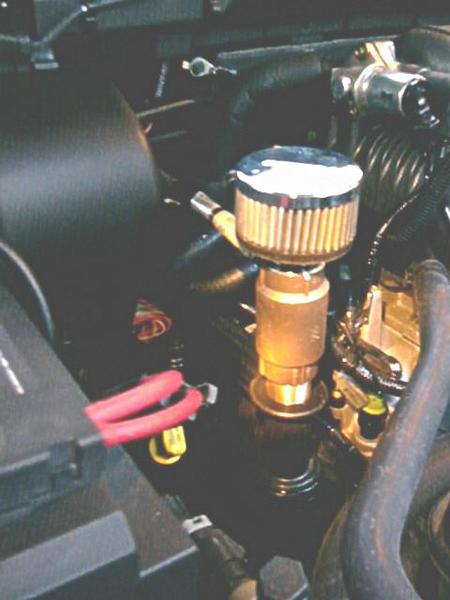
I made and used a check valve in the breather 3 years ago,
there are tons of post on it, works perfect, but I don't like the oil blowing all over.
However with Sals sweat band trick, I will be using it again, ; o )
I already found WAY TOO MUCH oil in the Inlet Boot and TB, with only a hundred miles on the new motor : o ( .
It def seems the more boost you have the more oil you have, so at 22lbs I REALLY need to stop "some"
Here's one old post I found from 02 with my check valve set up
https://www.f150online.com/forums/sh...light=Breather
Sorry back then my Camera wasn't too good
I used it for a while, and it worked perfect. no oil in the TB and boost, but as said my only complaint (besides the look), is the oil blowing all over.
BTW
got a few minutes to do the pumps yet
heheheeI made and used a check valve in the breather 3 years ago,
there are tons of post on it, works perfect, but I don't like the oil blowing all over.
However with Sals sweat band trick, I will be using it again, ; o )
I already found WAY TOO MUCH oil in the Inlet Boot and TB, with only a hundred miles on the new motor : o ( .
It def seems the more boost you have the more oil you have, so at 22lbs I REALLY need to stop "some"
Here's one old post I found from 02 with my check valve set up
https://www.f150online.com/forums/sh...light=Breather
Sorry back then my Camera wasn't too good
I used it for a while, and it worked perfect. no oil in the TB and boost, but as said my only complaint (besides the look), is the oil blowing all over.
Originally posted by Rob_02Lightning

Senior Member
Joined: Sep 2002
Posts: 2,031
Likes: 0
From: irving, texas
yup i noticed since my built motor (cams and heads) and maybe due to lower vaccum and ported eaton and 8lb of pulley, that i have been sucking in a lot more oil. it smokes and ingests oil a little and i can see lots of fresh oil going in to the pcv.
the point is, i dont want to ingest oil at all throught the pcv, i personally think its a bad idea all together. blowers have never needed lubed rotors. but maybe so i dont know, but im willing to try this check valved breather thing. Any source on parts?
the point is, i dont want to ingest oil at all throught the pcv, i personally think its a bad idea all together. blowers have never needed lubed rotors. but maybe so i dont know, but im willing to try this check valved breather thing. Any source on parts?

Senior Member
Joined: Jan 2003
Posts: 5,097
Likes: 0
From: DETROIT, (formerly Eaton County, Michigan)
Originally posted by Tim Skelton
82 posts and no one can explain why the rotors need to be oiled.
82 posts and no one can explain why the rotors need to be oiled.
Plus, (if you read the posts) you'll see that the rotors tend to be in better condition when they have oil on them. Less flaking.
I don't think the problem is that the supercharger has oil on the rotors. The problem is that the I/C gets coated with oil and reduces its efficiency.
Senior Member
Joined: May 2002
Posts: 4,928
Likes: 1
From: The People's Republic of Los Angeles
I understand completely why one wants to reduce the amount of oil going through the intake system.
With respect to the "seepage" issue, I am struggling to believe that for any compressor. Centrifugal compressors run the tightest tolerances known to mankind, fighting for every fraction of a point of efficiency. None to my knowledge inject any oil onto the compressor wheel.
I'm also doubtful of the oil causing less flaking on the rotors. There may be a statistical relationship, but that does not necessarily translate into cause and effect. Perhaps the people who run high boost also run oil separators -- and the high RPMs causes the teflon to flake off more. And I would be shocked if Eaton told OEMs to design in oil blowby to keep the rotors healthy. I think that the OEMs would tell Eaton to improve the teflon coating or remove it entirely.
With respect to the "seepage" issue, I am struggling to believe that for any compressor. Centrifugal compressors run the tightest tolerances known to mankind, fighting for every fraction of a point of efficiency. None to my knowledge inject any oil onto the compressor wheel.
I'm also doubtful of the oil causing less flaking on the rotors. There may be a statistical relationship, but that does not necessarily translate into cause and effect. Perhaps the people who run high boost also run oil separators -- and the high RPMs causes the teflon to flake off more. And I would be shocked if Eaton told OEMs to design in oil blowby to keep the rotors healthy. I think that the OEMs would tell Eaton to improve the teflon coating or remove it entirely.


Senior Member
Joined: Oct 2000
Posts: 507
Likes: 0
From: " Somewhere Between Lost & Found "
Someone posted way back about, our valve-cover's not having a baffle. If this is the origin point of oil being sucked into system has, anyone come -up with baffled covers and what were the results of it stopping the oil from being drawn into pcv valve?