When you click on links to various merchants on this site and make a purchase, this can result in this site earning a commission. Affiliate programs and affiliations include, but are not limited to, the eBay Partner Network.
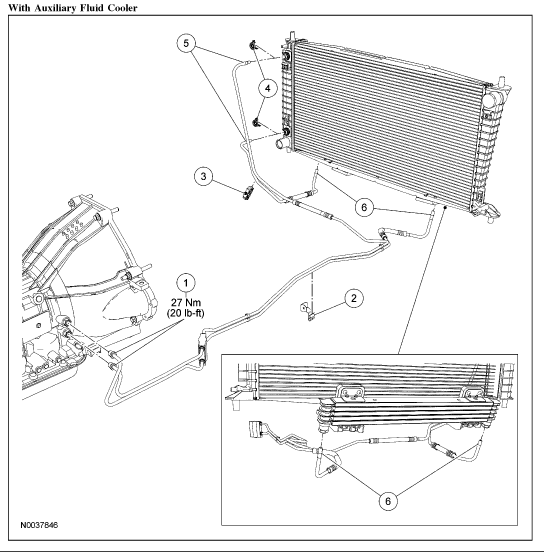
Hi guys..a few years back my factory transmission cooler developed a leak. Local shop did repair. They asked if I used truck for towing..when I said no they offered to just bypass leaking cooler to save money. I would now like to put an aftermarket cooler back..is it as simple as cutting this line in the pic and attaching to each end of the cooler? Is it under pressure? The hose is marked 3/8"..do I need a cooler with this size inlet/outlet lines?
The factory transmission cools through the radiator. On the driver's side of the radiator, the transmission line at the top sends hot fluid in. The lower line is returning cool fluid. That lower line goes to an auxiliary cooler on some models, and directly back to the transmission on other models. If you need to, look up your VIN on parts.ford.com , and you can buy the correct tubing and connectors.
Since the shop installed a 3/8" length of transmission hose, you should look for an aftermarket cooler with the correct fitting size. You will be cutting into the line with the truck off, so there won't be any pressure from the transmission pump. Have some shop rags and a pan handy. Fluid will leak out when you cut into the line. Have an extra quart of ATF handy. You may want to add a little to make up for what came out of the line. Your truck uses Mercon V. Do not use any other type of fluid. Not Mercon in any other flavor. Not Dexron. Not universal ATF that an auto parts store will try to sell you.
If you do it yourself, you can install any kind of cooler that you want. The bigger, the better. If you are handy, and have a few tools, this could be very easy. You could have the job done in 15 minutes. Drill a few holes. Hang the cooler. Connect the lines.
You could use a simple tube and fin cooler. Lowest cost.
Here are a few things that I discovered over the years.
Do not use those "zip tie style" things that you have to run though the fins of your radiator and the fins of the cooler. Over time, those will just add stress, plus wear and tear, to the fins of the radiator and the cooler. Plus, your fan and fan shroud will make it difficult to access the back side of the radiator.
Metal bracket strips come in all sorts of sizes at hardware stores, and online. You probably will not find anything with the exact same hole diameter as the cooler. You will have to think along the lines of bigger washers and lock washers to make it all work. Use a drill bit stop collar. You don't want to drill into the radiator. On my truck, because of the hardware which was available at the time, my cooler is hanging from metal brackets, with the lower mounting holes attached to the truck body.
A lot of aftermarket cooler installation guides will recommend that you route the cooling and return lines in certain configurations. Which mostly makes sense. As the OEM configuration with the inlets and outlets at the bottom, is not the best idea. As hot fluid is pumped up into the cooler, the fluid could pass to the outlet, without going up into all of the plates. Not an issue with a tube & fin style cooler, because you don't worry about a pocket of air in the plates. Yet, this is how the OEM's do it, so I'm not worried. A lot of cooler manufacturers suggest to mount the cooler sideways, with the top port as the inlet, and the lower port as the outlet. This is how your truck's radiator is configured. The cooling line with hot fluid goes to the top of the radiator, heat rises, gravity pulls the fluid down, with the lower line returning cooler fluid. Do not reverse that with hot fluid going in the bottom port. If space allows, you can always get extra lengths of transmission line, and mount the cooler with the ports facing up. Then hot fluid fills the cooler and there won't be an air pocket effect.
It will cost you a little money. But you may consider monitoring the transmission fluid temperature. The truck's transmission control module uses a sensor in the transmission, which you read via OBD II. The transmission also has a test port which you can use to install an old fashion gauge. Some people install more than one gauge, so that they can see the temp of hot fluid being pumped out, cool fluid being returned, and pan temperature. Why? I don't know. I would not know what to do with all of that information. We already know that the hot fluid in the cooling line is higher, the return line will be cooler, and that the pan will be between those numbers.
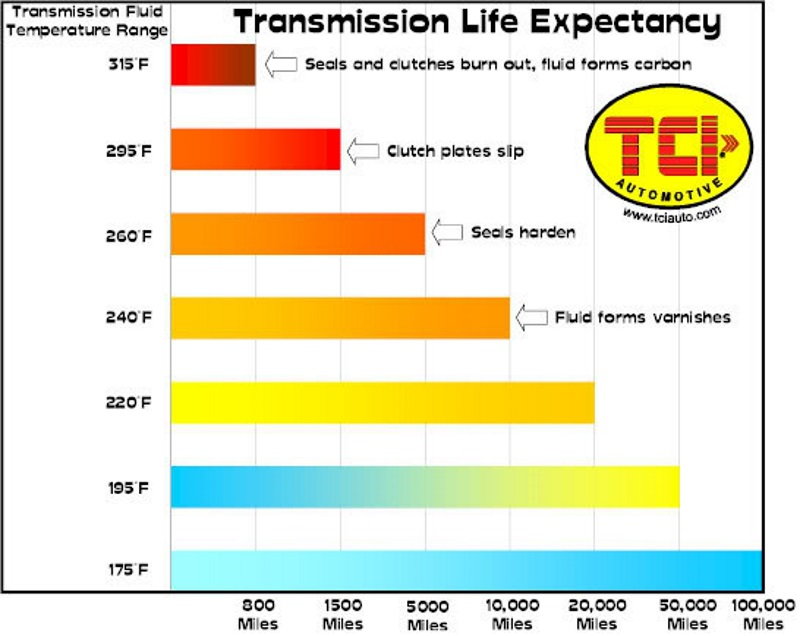
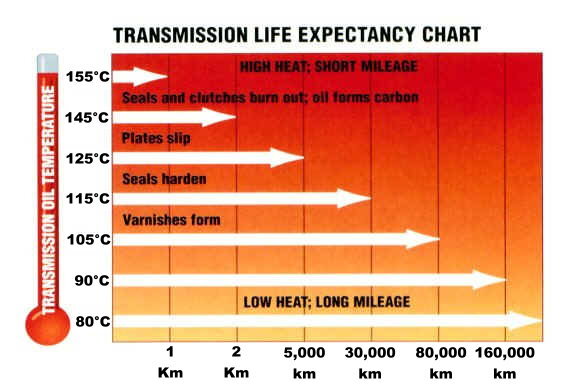
I have a ScanGauge, will I will glance down at occasionally. My truck has never had the engine or transmission overheat. And for awhile, I drove myself crazy wondering if there was a problem or if it was accurate. My point and shoot thermometer would show all sorts of different numbers when I pointed it at the cooler inlet, cooler outlet, transmission lines at different parts of the system, the transmission pan, the actually transmission body where the torque converter is........ I went from being just curious, to thinking that there was a problem where none existed. Then there are all of charts all over the internet to make you think that your transmission is burnt toast.
Last edited by Fifty150; Mar 22, 2024 at 03:07 AM.