An article by
Andy Edge
Webmaster Note: I want to gratefully acknowledge Andy Edge and Chris Bagley for contributing this article and photos. It has been several months since this was submitted and I want to apologize to them for the delay in getting it on the site.
Background
A while back, we were sent some pictures of offroading trips to the beach and we were curious how the trucks can handle the beach travel. From what we were told by the photographers, Chris Bagley (Suffolk, VA) and Andy Edge (Washington, NC), there is nothing to it...read on...About Chris' Truck
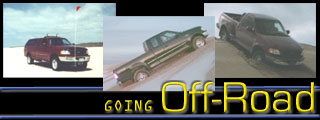
It is a red 1997 Flareside 4x4 with a 4.6l v8, complete with Superchip (great bang for the buck according to Chris), K&N air filter, Autolite Double Platinum plugs, high performance plug wires and a MagnaFlow exhaust system. Enhancing the trucks good looks are Smittybilt Outland chrome brush guards with KC driving lights, chrome nerf bars, chrome brake light covers, bug shield, vent visors, Challenger diamond plate toolbox and tinted windows. No trick F-150 would be complete without a Ford logo on the back window, custom 4x4 stickers with a matching pin stripe and beefy 285/75/16 (33") tires.About Andy's Truck
It is a white extended cab Lariat edition with a 4.6l v8 which is basically stock, with the exception of glas pak instead of the muffler, custom made ram air system, chrome brush guard, push bar and roll bars. Like Chris' truck, Andy's F-150 proudly displays the Ford name, in the form of a Ford Motorsports SVO decal on the front window. Based on the article that Andy sent us. These trips to the beach are quite a lot of fun! Aside from the usual activities (including a side trip to Big Al's 50's diner), a good trip might include pulling a Chevy or Jeep out of a sand dune!
Commentary By Andy Edge
Some time on the beach is a great way to have fun and test the ability of the four wheel drive Fords trucks. On most off road surface, trucks need a lift and/or aftermarket tires to perform. However, none of this equipment is needed on the sand. The most important elements for a beach runner? An air pressure guage and four wheel drive. A two wheel drive truck, no matter what the setup, will not make it far on the beach, and likely spend more time hitched to another truck trying to get out of their own ruts.
Once the driver enters the beach access area, the best thing to do is deflate the tires to around 20psi. This allows them a wider foot on which to stay above the sand, rather than pushing sand up, causing deep ruts that, in turn make the power plant work harder and ultimately become stuck. I have found that it works well to deflate the front tires slightly more than the rear, as they will need better traction to turn and move out of small ruts made by others.
Be aware, deflating a tire can have two effects. It is the biggest aid next to four wheel drive, but it can become your enemy if the tire is overdeflated and knocked out of the beed. If that occurs, your options are to reinflate the tire with a small air pump (this will more than likely never work) or to change the tire. The latter is next to impossible, as the truck needs to be jacked up on SAND, a near impossibility on a soft shifting surface. This will likely lead to even worse problems.
Another tip while traveling on sand is to operate in 4 wheel drive HIGH, rather than 4 wheel drive LOW. It is important to keep moving on sand and 4x4 LOW has a tendency to bog down, which makes it more difficult to keep moving through the sand. Once the truck gets moving through the sand, it is much easier to maintain that movement, rather than slowly trudging through.
The two tips? 1) Use 4 wheel drive HIGH and 2) Low air pressure. Remember, deflate the tires to around 20psi, with the slightly lower pressure in the front tires. Another good tip is to bring a friend that also has four wheel drive. This friend will preferably drive a Ford as well. Of course, if they have a Chevy, you may get some great pictures. Oh yeah, don't forget to reinflate your tires once you leave the beach!