


Can't solve EGR (P0401) problem


Thread Starter
|
Junior Member
Joined: Aug 2003
Posts: 6
Likes: 0
From: Nebraska
 Can't solve EGR (P0401) problem
I'm nearing the end of my rope with a problem I'm having with my '97 F150. About a month ago the Check Engine Light (CEL) came on with a P0401 code (EGR Insufficient Flow). Since that time,
I checked and cleaned and reinstalled the EGR valve...light came back on.
I then replaced the valve ($65)...light came back on.
I then replaced the Vacuum Regulator ($25)...light came back on.
My next step was to replace the DPFE sensor (which I checked for proper voltage and it seemed to be OK), but I began to see a pattern emerge, so rather than simply buy a new sensor, I decided this might be out of my league, so I took the truck to my Mechanic.
At the end of the day, he ended up checking/cleaning out the passageway from the EGR Valve into the engine, and replaced the sensor.
I took the truck home...no light, but the next morning...light came back on. I called my Mechanic and he asked me to clear the code out again and see if it stayed off.
Well, as you can probably guess (since I'm posting), the light came back on.
Does anyone have any ideas I might try or suggest for my Mechanic??? I was wondering if the pipe from the exhaust to the EGR valve might be partially blocked at the orifice, or could there be some other sensor or part that tells the computer that there might be insufficient EGR flow?
Any and all suggestions are greatly appreciated. I will post the results as I make progress. Thank you!
I checked and cleaned and reinstalled the EGR valve...light came back on.
I then replaced the valve ($65)...light came back on.
I then replaced the Vacuum Regulator ($25)...light came back on.
My next step was to replace the DPFE sensor (which I checked for proper voltage and it seemed to be OK), but I began to see a pattern emerge, so rather than simply buy a new sensor, I decided this might be out of my league, so I took the truck to my Mechanic.
At the end of the day, he ended up checking/cleaning out the passageway from the EGR Valve into the engine, and replaced the sensor.
I took the truck home...no light, but the next morning...light came back on. I called my Mechanic and he asked me to clear the code out again and see if it stayed off.
Well, as you can probably guess (since I'm posting), the light came back on.
Does anyone have any ideas I might try or suggest for my Mechanic??? I was wondering if the pipe from the exhaust to the EGR valve might be partially blocked at the orifice, or could there be some other sensor or part that tells the computer that there might be insufficient EGR flow?
Any and all suggestions are greatly appreciated. I will post the results as I make progress. Thank you!

Technical Article Contributor

Joined: Dec 1997
Posts: 9,417
Likes: 11
From: Windsor,Ontario,Canada
greg182,
Yes, test the DPFE.
Disconnect pressure hoses at D.P.F. EGR sensor.
Connect a hand vacuum pump to the downstream connection at sensor (intake manifold side of sensor or the smaller diameter pickup tube.)
Key on, engine off.
Access DPFEGR PID and note PID value.
Apply 27-30 kPa (8-9 in-Hg) vacuum to the D.P.F. EGR sensor and hold for a few seconds.
Quickly release vacuum.
-- The DPFEGR PID voltage must be between 0.2 and 1.3 volt with the key on and no vacuum applied.
-- The DPFEGR PID voltage must increase to greater than 4.0 volts with the vacuum applied.
-- The DPFEGR PID must drop to less than 1.5 volts in less than 3 seconds when vacuum is released.
Does the DPFEGR PID voltage indicate a fault in the D.P.F. EGR sensor?
Yes
REPLACE D.P.F. EGR sensor.
Regards
Jean Marc Chartier
Yes, test the DPFE.
Disconnect pressure hoses at D.P.F. EGR sensor.
Connect a hand vacuum pump to the downstream connection at sensor (intake manifold side of sensor or the smaller diameter pickup tube.)
Key on, engine off.
Access DPFEGR PID and note PID value.
Apply 27-30 kPa (8-9 in-Hg) vacuum to the D.P.F. EGR sensor and hold for a few seconds.
Quickly release vacuum.
-- The DPFEGR PID voltage must be between 0.2 and 1.3 volt with the key on and no vacuum applied.
-- The DPFEGR PID voltage must increase to greater than 4.0 volts with the vacuum applied.
-- The DPFEGR PID must drop to less than 1.5 volts in less than 3 seconds when vacuum is released.
Does the DPFEGR PID voltage indicate a fault in the D.P.F. EGR sensor?
Yes
REPLACE D.P.F. EGR sensor.
Regards
Jean Marc Chartier
Thread Starter
|
Junior Member
Joined: Aug 2003
Posts: 6
Likes: 0
From: Nebraska
My mechanic did replace the DPFE sensor, but that didn't seem to do the trick. Now, I guess, it is a possibility that the sensor might be malfunctioning.
I don't have a hand vacuum, but I could get one to test the new sensor to be sure it's functioning correctly.
Do you think that could still be the problem?
Thanks,
greg
I don't have a hand vacuum, but I could get one to test the new sensor to be sure it's functioning correctly.
Do you think that could still be the problem?
Thanks,
greg

Senior Member
Joined: Mar 2002
Posts: 451
Likes: 0
From: SE Texas
Make sure the EGR is getting vacuum.
Battery acid tends to eat up the vacuum lines between the firewall and the battery.
With the engine running, take the vacuum hose off the EGR valve and put your thumb over it, you should feel a slight pulsation at the hose end.
Battery acid tends to eat up the vacuum lines between the firewall and the battery.
With the engine running, take the vacuum hose off the EGR valve and put your thumb over it, you should feel a slight pulsation at the hose end.
Thread Starter
|
Junior Member
Joined: Aug 2003
Posts: 6
Likes: 0
From: Nebraska
I did check that a while ago (before the new DPFE sensor and Vacuum regulator replacements). I did feel a faint pulse on the end of the hose but there wasn't much vacuum.
I did suction the EGR Valve when the engine was running, and it began to idle quite rough, so I figured exhaust was making it back into the engine thru the valve.
I will check the vacuum lines again just to be sure there isn't a blockage and that I feel a pulse.
I guess I just feel that after replacing the Valve, Regulator, and Sensor, that should have taken care of the problem, but evidently the PCM still detects insufficient flow in the system. I did find some debris in the hoses attached to the Sensor so I blew them out, and used an old brake cable to clear out the connections to the exhaust pipe.
I will go down the list again and see if I maybe missed a step, and recheck my new components to be sure they're doing their jobs.
Thanks for all the help. Sometimes you just need a few outside tips to get you pointed in the right direction.
greg
I did suction the EGR Valve when the engine was running, and it began to idle quite rough, so I figured exhaust was making it back into the engine thru the valve.
I will check the vacuum lines again just to be sure there isn't a blockage and that I feel a pulse.
I guess I just feel that after replacing the Valve, Regulator, and Sensor, that should have taken care of the problem, but evidently the PCM still detects insufficient flow in the system. I did find some debris in the hoses attached to the Sensor so I blew them out, and used an old brake cable to clear out the connections to the exhaust pipe.
I will go down the list again and see if I maybe missed a step, and recheck my new components to be sure they're doing their jobs.
Thanks for all the help. Sometimes you just need a few outside tips to get you pointed in the right direction.
greg
Technical Article Contributor
Joined: Dec 1997
Posts: 9,417
Likes: 11
From: Windsor,Ontario,Canada
greg,
Clear the codes and have the new code read. It might not be the same code. If it is;
Visually inspect both pressure hoses for reversed connection at D.P.F. EGR sensor or at orifice tube assembly.
Inspect both hoses for improper routing. Hoses should not be pinched or have dips where water could settle or freeze.
Inspect both hoses for leaks and blockage.
lInspect D.P.F. EGR sensor and orifice tube assembly for blockage or damage at the pickup tubes.
Regards
JMC
Clear the codes and have the new code read. It might not be the same code. If it is;
Visually inspect both pressure hoses for reversed connection at D.P.F. EGR sensor or at orifice tube assembly.
Inspect both hoses for improper routing. Hoses should not be pinched or have dips where water could settle or freeze.
Inspect both hoses for leaks and blockage.
lInspect D.P.F. EGR sensor and orifice tube assembly for blockage or damage at the pickup tubes.
Regards
JMC
Senior Member
Joined: Mar 2002
Posts: 451
Likes: 0
From: SE Texas
greg182
You have pretty much exhausted all the possible EGR components.
I would check the wiring at this point. The PCM harness shorts out on the A/C accumulator by the battery.
You can take a small mirror and look under the harness right where it sits on the accumulator. Look for bare wires.
You have pretty much exhausted all the possible EGR components.
I would check the wiring at this point. The PCM harness shorts out on the A/C accumulator by the battery.
You can take a small mirror and look under the harness right where it sits on the accumulator. Look for bare wires.
Trending Topics

Junior Member
Joined: Aug 2003
Posts: 1
Likes: 0
From: Lewisville, Texas
go farther
as someone previously has stated check the datastream while the engine is not running but key on. the voltage from the dpfe should be between 0.3 -1.3 volts . start the truck and observe the dpfe and egrvr pid as you slowly accel from a stop. on a normally warm engine the egrvr pid will increase until the dpfe sensor sees some change in the voltage. the normal will be the % reading at the egrvr pid will get to about 40% then the voltage at the dpfe sensor will start up the scale. the more % you see the more voltage. the egrvr is the vacumn regulator for the activation of the egr valve. when egr gas flows the dpfe sensor voltage changes accordingly. exhaust being hot and full of water vapor will corrode the things it comes in contact with..ie. dpfe sensor, plumbing, valves so on and so on. if there is any oil vapor also in the exh then the problem can grow rapidly. I hope this can help ur mechanic :

Thread Starter
|
Junior Member
Joined: Aug 2003
Posts: 6
Likes: 0
From: Nebraska
Thanks for all the great responses. I will print them off and pass them along. At this point, my Mechanic is checking other resources to try and resolve this problem. My truck has about 72k miles and I only live about 10 min. from work, so it takes a lot of short trips. I was thinking it could be some buildup in some hoses or something, but I've checked all those.
One thing I'm not sure about: I heard that completely opening the EGR valve should cause the engine to stall. When mine is opened, it just idles kinda rough, but doesn't ever act like it will stall.
I'm determined to lick this thing, and so far, it's cost me about $200 for all parts & labor, but I'ld gladly pay another $200 to put this one behind me. I will certainly have your suggestions tested to narrow this thing down. In the end, I'm convinced it will be a $2.47 part that was to blame.
Thanks again!
greg
One thing I'm not sure about: I heard that completely opening the EGR valve should cause the engine to stall. When mine is opened, it just idles kinda rough, but doesn't ever act like it will stall.
I'm determined to lick this thing, and so far, it's cost me about $200 for all parts & labor, but I'ld gladly pay another $200 to put this one behind me. I will certainly have your suggestions tested to narrow this thing down. In the end, I'm convinced it will be a $2.47 part that was to blame.
Thanks again!
greg

Member
Joined: Jul 2002
Posts: 37
Likes: 0
From: largo florida
code 401
Maybe I missed this, but did you take off the throttle body elbow and clean the 2 ports? That is what my problem was. I took off the elbow and those ports were completely clogged with carbon. I believe I have seen pictures when I did a search on this subject. It will be easy to do since you have replaced the egr. Get a new gasket before you take off the elbow. After I cleaned the elbow, the cel light went off by itself the next day. I did not reset it. hopefully that is your problem.
Thread Starter
|
Junior Member
Joined: Aug 2003
Posts: 6
Likes: 0
From: Nebraska

Well, as it turns out I was wrong. It didn't cost $2.47 to fix the problem....it was practically free!
Sure enough, there was a TON of carbon build up in the 2 ports coming from the EGR tube into the elbow. I can't believe that any exhaust could have been entering the engine through those ports at all! When I would open the EGR valve, the engine would idle a bit rough, but given the severe restriction, I have no idea how!
I wasn't able to remove the elbow because I didn't want to tackle the back bolt. I could barely get my socket on the bolt because it was so close to the truck body. Instead, I just removed the throttle assembly so I could reach the deposits in the elbow. I just stuffed a rag down into the elbow, and began scraping the deposits out of the 2 ports. I used a vacuum with a small hose to help remove as much of the carbon as possible after I had scraped the ports with a tool I had to craft that would bend back on itself.
I cleaned it our fairly well, but I'll probably be back in there. I'll have to figure out how to remove the elbow to do it right.
After I re-assembled everything I started it up and it ran really rough and eventually died. At that point, I feared I would need a tow to the nearest dealer...instead, I had just forgotten to reconnect a vacuum line on the passenger side of the assembly. Once that was reconnected, I started it up, and it idled great! I still need to road test it, but so far, no light.
Thanks again to everyone! I hope this thread can help the next owner with the dreaded P0401.
greg
(signing off....for now)
Sure enough, there was a TON of carbon build up in the 2 ports coming from the EGR tube into the elbow. I can't believe that any exhaust could have been entering the engine through those ports at all! When I would open the EGR valve, the engine would idle a bit rough, but given the severe restriction, I have no idea how!
I wasn't able to remove the elbow because I didn't want to tackle the back bolt. I could barely get my socket on the bolt because it was so close to the truck body. Instead, I just removed the throttle assembly so I could reach the deposits in the elbow. I just stuffed a rag down into the elbow, and began scraping the deposits out of the 2 ports. I used a vacuum with a small hose to help remove as much of the carbon as possible after I had scraped the ports with a tool I had to craft that would bend back on itself.
I cleaned it our fairly well, but I'll probably be back in there. I'll have to figure out how to remove the elbow to do it right.
After I re-assembled everything I started it up and it ran really rough and eventually died. At that point, I feared I would need a tow to the nearest dealer...instead, I had just forgotten to reconnect a vacuum line on the passenger side of the assembly. Once that was reconnected, I started it up, and it idled great! I still need to road test it, but so far, no light.
Thanks again to everyone! I hope this thread can help the next owner with the dreaded P0401.
greg
(signing off....for now)


Junior Member
Joined: Mar 2007
Posts: 4
Likes: 0
I've got the same P0401 error as many have had. I want to try and clean the ports, but I'm not sure where they are.  The pictures on the thread above are no longer available.
Can someone point me to where they are?
Thanks,
DrA>
The pictures on the thread above are no longer available.Can someone point me to where they are?
Thanks,
DrA>

Technical Article Contributor
Joined: Oct 2005
Posts: 25,641
Likes: 19
From: MI
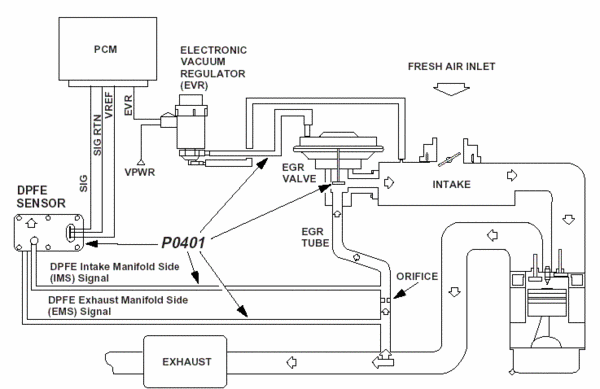
You can see most of the ports in this thread.
https://www.f150online.com/forums/sh...d.php?t=277763
Heres some good pointers here -
http://www.fordf150.net/howto/throttlebodyclean.php
Last edited by jbrew; Mar 17, 2007 at 07:22 PM.